

Man’s relationship with the gods passed through two regimes: first conviviality, then rape. The third regime, the modern one, is that of indifference, but with the implication that the gods have already withdrawn, and, hence, if they are indifferent in our regard, we can be indifferent as to their existence or otherwise. Such is the peculiar situation of the modern world.

When Apollo sends death it arrives from distance, the god himself always remains hidden. That’s what his epithet means. Hekatebolos. Far-Shooter. Of all the Olympians he epitomises withdrawal, choosing not to claim a mortal hero and his journey for companionship or pride. His lofty, aloof nature burns with the qualities expected of the sun itself, purity and radiance, clarity and illumination. He is also iatromantis, divine seer, patron of oracular wisdom and visions through incubation.
Then Apollo, the son of Zeus, smiled upon them and said: “Foolish mortals and poor drudges are you, that you seek cares and hard toils and straits! Easily will I tell you a word and set it in your hearts. Though each one of you with knife in hand should slaughter sheep continually, yet would you always have abundant store, even all that the glorious tribes of men bring here for me.”
Walter Otto, in The Homeric Gods, describes Apollo in a manner now out of fashion. Otto’s Apollo is inhuman, which is harder to write than it sounds. We use inhuman largely as an intensifier for cruelty: inhuman conditions, inhuman treatment, ultimately meaning cruelty pressed past what ordinary people do to each other. However, Otto means something stark, the god is operating at a register where the human scale is simply irrelevant. The god acts and things are altered, and there is no affect in the altering.
This quality is what the archaic epithet carries. Apollo Lykeios. The wolf-god. The etymology is disputed - lykos, wolf, or Lycia, the region, or a root connected to light - but the wolf reading is not forced. The Lyceum in Athens, where Aristotle taught in a grove sacred to Apollo Lykeios, was not named after an abstraction. Something in his cult felt his wolf-nature - the focused calm, the total economy of motion, the relationship to his prey that lacks malice.
Predators are not cruel. As Nietzsche wrote - the lambs whisper among themselves, ‘These birds of prey are evil, and does this not give us a right to say that whatever of the opposite of a bird of prey must be good?’, there is nothing intrinsically wrong with such an argument - though the birds of prey will look somewhat quizzically and say, ‘We have nothing against these good lambs; in fact, we love them; nothing tastes better than a tender lamb’. Cruelty requires the kind of attention to suffering that takes suffering as its object. The wolf tracking through snow is not attending to the suffering of what it hunts. It is attending purely to the hunt, death is simply completion.
Walter Burkert, analysed the ritual patterns behind Greek sacrifice and the sacred hunt in Homo Necans, and traced how violence and purification share the same gesture, i.e. the priest’s knife and the healer’s herb both belong to the god who sends plague and the god who ends it. Apollo kills with arrows and Apollo kills with disease and Apollo is also the physician’s god. Burkert understood purification in the archaic Greek sense as ecological, rather than moral. If the system had been disturbed - the system then returned to balance. Coronis was pregnant with Apollo’s child, yet she betrayed him with Ischys, and the god requested his sister slay Coronis on the shore of Lake Boebeis. Her last utterance that Apollo had also killed his own son was undone, as he rescued the infant Asclepius from the funeral pyre, the babe a future prodigy of healing and of medicine.
Across so many descriptions, Apollo demonstrates a nature detached yet capable of intense, overwhelming focus. When Marsyas loses the contest and is flayed alive for his presumption, the god is not inflamed by victory or offended pride - the flaying is almost administrative. The satyr exceeded his boundary, and the boundary reasserted itself. There was agony in this reassertion, but agony doesn’t change anything. When Apollo fixated on you, there was no evading his relentless, obsessive chase. Daphne didn’t want to burn, the god of youth crowned his victors with her leaves.
This is a quality that has become difficult to emulate or inhabit, now almost inaccessible. We can still reach Dionysus because his darkness is passionate. Excess, frenzy, dismemberment, the self dissolving into the mob and the god and the wine. Certain music is Dionysian, so is grief that cannot be consoled. Alcohol, loss of self-control and ego. Dionysus has been maintained because there are legible vessels and channels for passion, even destructive passion, and those containers invite identification with the force that overwhelms the self.
In contrast, Apollo’s darkness offers little by way of invitation. It does not overwhelm, he does not want anything from you. The Far-Shooter operates from a distance, he cannot be humanised. Remote, indifferent, withdrawn. Buddhist traditions produced a word for the being who has attained complete enlightenment and remains in the world, acting in the world, without attachment to outcomes - a bodhisattva. Complete competence, no ordinary affect, the capacity for actions that are genuinely terrible, a gaze that does not flinch. The bodhisattva does not suffer with the suffering.
Over the centuries Apollo has been smoothed and moulded into the god of reason and of beautiful forms, which are safe and curatable things. He has been gradually moved into a museum and held up as the exemplar of Hellenic rationality. What was dimished in doing this was the experience of a particular kind of sacred terror, encountering a power that is neither malevolent nor benevolent, that acts with absolute precision, and that will do so whether or not you are watching.
Peter Kingsley, from his book In the Dark Places of Wisdom:
For the Greeks the god of this other state of awareness was Apollo. In his consciousness space and time mean nothing. He can see or be anywhere; past and future are as present as the present is for us. And so he was a god of ecstasy, trance, cataleptic states-of states that take you somewhere. There was a single word in Greek to express this; it meant ‘taken by Apollo’. Apollo’s ecstasy was different from the ecstasy of Dionysus. There was nothing wild or disturbing about it. It was intensely private, for the individual and the individual alone. And it happened in such stillness that anyone else might hardly notice it or could easily mistake it for something else. But in this total stillness there was total freedom at another level.
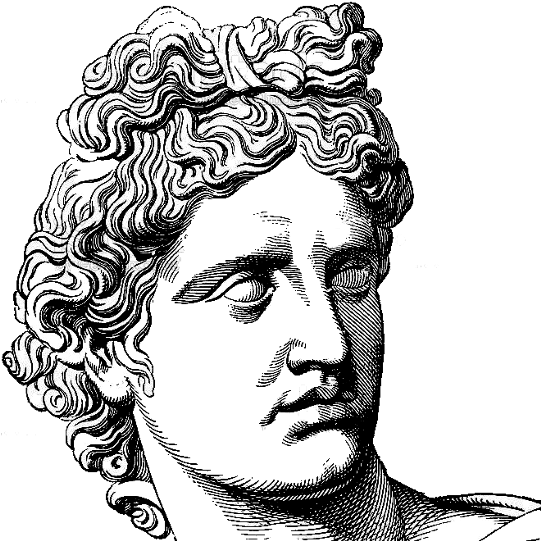
The reconstructed Proto-Indo-European noun *kóryos, meaning unit of warriors is now widely accepted. It denotes landless bands of unmarried young men who lived on the social margins, raiding, self-identifying with wolves and dogs as symbols of death and lawlessness. The Männerbund framework under which the kóryos exists derives from early German scholarship and was developed within Indo-European studies by Georges Dumézil and Stig Wikander. Since the 1980s the field has subjected it to critical re-examination. The result has been a compromise, for while *kóryos is securely reconstructible, it’s unclear that it should be equated with the Männerbund.
Apollo’s connection to the Indo-European war band is also unclear, but we do have more to work with. Firstly his epithet Lykeios (typically etymologised as ‘wolf-like’ or ‘wolf-slayer’ [Lykoktonos] or ‘Lycian’). Then Apollo’s patronage of the ephebeia, whose members fought by ambush and night-raid (Athens) and the Spartan krypteia, the ‘human hunt’. Finally the bronze wolf that guarded Apollo’s temple at Delphi. The comparative mythologist Bernard Sergent collected his lifetime of research in Homosexualité et initiation chez les peuples indo-européens (1996). Sergent interpreted myths such as Apollo & Hyakinthos, Kyparissos and Narkissos as encoding erotic male rites of passage from boyhood to adult warrior status, stressing Apollo’s wolf-link, his northern (Boreas) associations and the possible Indo-European origin of these rites. Kershaw’s The One-eyed God: Odin and the (Indo-)Germanic Männerbünde also situates the Greek evidence within a pan-Indo-European complex of an ecstatic war-band god, connecting Apollo the Wolf with the Vedic Vrātyas/Rudra-Maruts and the Germanic Odin/Einherjar.
Interestingly, Dumézil himself explicitly regarded Apollo (and Achilles) as non-Indo-European figures which had been later absorbed into Greek tradition. On the historical-institutional side, the mainstream reading (Angelo Brelich, Paides e Parthenoi, and Fritz Graf, Apollo) treats Apollo’s youth/initiation role as a feature of the historical polis (the god of the ephebes and of civic incorporation) rather than direct evidence of an Indo-European wolf-cult. Scholar Michael H. Jameson’s chapter Apollo Lykeios in Athens in his book Cults and Rites in Ancient Greece, reads the Lykeion gymnasium connection in civic-ephebic terms. Walter Burkert’s Apellai und Apollon connected the Doric Apellōn to the apellai, the kinship-festival of youth-initiation, making Apollo “the prototype of the young men to be received in the initiation festival”.
For Apollo, possession is a conquest. And, like every conquest, it must be defended by an imperious hand. Like every conquest, it also tends to obliterate whatever power came before it. But the possession that attracted Apollo was very different from the possession that had always been the territory of Dionysus. Apollo wants his possession to be articulated by meter; he wants to stamp the seal of form on the flow of enthusiasm, at the very moment it occurs. Apollo is responsible for imposing logic too: a restraining meter in the flux of thought. When faced with the darting, disordered, furtive intelligence of Hermes, Apollo drew a dividing line; on the one side Hermes could preside over divination by dice and bones, could even have the Thriai, the honey maidens, despite his elder brother’s once having loved them, but the supreme, the invincible oracle of the word, Apollo kept for himself.
Apollo the Shaman is another popular reading of his nature. Karl Meuli in Scythica, argued that archaic Greek ecstatic figures reflected contact with Black Sea and Scythian shamanism. In chapter five of E. R. Dodds’ famous work The Greeks and the Irrational (1951), he dramatised this, with figures such as Abaris (the Hyperborean who carried Apollo’s arrow, fasted, banished plague, and flew on the arrow) and Aristeas of Proconnesus (whose soul left his body in the form of a bird and who journeyed north) as ‘Greek shamans’, along with Hermotimus, Epimenides, Pythagoras and Orpheus. Dodds argued for foreign influences on three grounds: that such behaviour appears only when the Black Sea opened to Greek colonisation; that the earliest ‘shamans’ are Scythian (Abaris) or had visited Scythia (Aristeas); and that there are concrete Greek-Scythian/Siberian parallels such as the shamanic sex-change.
These are strong claims for any classical era topic. Jan N. Bremmer in The Early Greek Concept of the Soul accepted the soul-journey data for Aristeas/Hermotimus - but he reinterprets it via the anthropological ‘free soul’ model. Thus the wandering soul in a trance reflects an indigenous Greek belief in a psychē/free-soul which is active outside the body, and is not necessarily a Siberian import. Historian Ioan Couliano preferred iatromantis to shaman, those ‘healer-seers, tied to Apollo Hyperboreus. Many others would prefer to abandon the concept of a Greek shaman altogether, arguing that the term is complex and difficult enough to analyse within Siberia and Mongolia, let alone amongst the ancient Hellenes.
Apollo didn’t want slovenly shamans but young virgins from the grottoes of Parnassus, girls still close to the Nymphs, and speaking in well-turned verse.
On the subject of Apollo and altered states of consciousness we can go further, to the oracular trance at Delphi and the Pythia’s ecstatic possession. Some might know the geological hypothesis of de Boer, Hale & Chanton: their paper New evidence for the geological origins of the ancient Delphic oracle (Greece) identified intersecting faults beneath temple and ethane/methane/ethylene in spring water, reviving Plutarch’s pneuma. This has been contested of course. Giuseppe Etiope from the National Institute of Geophysics and Volcanology in Rome, argued that any effect of the fault lines came from an oxygen deficit. Academics Fontenrose and Maurizio took a different path, disagreeing with the vision of the Pythia as frenzied, babbling and ecstatic, saying that this is itself a later topos and that the Pythia’s utterances were perfectly coherent. Both Kerényi and Burkert treat the Apolline mantic complex as genuinely possession-based but they resist reducing it to imported shamanism.
Cyrene had beaten the lion yet again. To have her surrender her virginity without regrets, Apollo chose one of his most secret forms: the wolf. It was the form that would give most pleasure both to her and to himself.
Everyone knows that Apollo came from the north, he took shelter with those who live in the frigid wastes. Three strands - firstly the Hyperborean myths themselves, that Apollo wintered beyond the north wind, Leto reportedly came to Delos from Hyperborea (in Aristotle’s report, she came with a pack of wolves), the Hyperboreans sent straw-wrapped first-fruits via Dodona to Delos (so say Herodotus, Pindar and Callimachus); then the Dorian migration theory - the Homeric Hymn to Apollo depicts him as a northern intruder, the month Apellaios in north-west Greek calendars and the apellai link Apollo to the Dorians; finally the archaeogenetics: Lazaridis et al., Nature (2017) and Science (2022) revealed that Mycenaeans averaged ~8.6±2% steppe/Yamnaya-like ancestry, with individuals ranging from 0% up to 19±7% at Kastrouli and 12±2% at the Palace of Nestor; Middle Bronze Age northern-Greek individuals had ~50% Pontic–Caspian steppe ancestry, with the gene flow estimated at approx 2300 BC. This confirms a real northern steppe contribution.
However, this genetic influx is too early (Early/Middle Bronze Age) to map onto any Iron Age arrival of an Apollo cult, and the elite Mycenaeans showed no distinct ancestry profile. As Lazaridis et al. (Science 2022) put it, “Mycenaean period elites in Greece did not differ from the general population, and included both people with some steppe ancestry, and others, like the Griffin Warrior, without it.” The Dorian invasion theory has been widely rejected today. Annie Schnapp-Gourbeillion called it a ‘spectre’ haunting historians of Greece, the migration model is dismissed by most as a ‘scholarly mirage’, with ancient-DNA continuity between Mycenaean and Iron Age populations.
The German tradition itself split anyway - Martin P. Nilsson emphasised Apollo’s Anatolian roots, as did Robert Beekes, who declared that “Burkert’s etymology deriving the name Apollo from a Dorian word for ‘assembly’, apella, is linguistically and historically impossible”. He further argued that “Apollo is a Pre-Greek-Anatolian name. The expected proto-form ... is found in the name Appaliunas, a god of Wilusa/Ilios mentioned in a Hittite letter” a position supported by the Homeric epithet Lykegenes, “an archaic formation meaning ‘born in Lycia’,” fitting “the strong Anatolian connections of Apollo as well as his mother Leto and his sister Artemis.” The classicist Ulrich von Wilamowitz-Moellendorff identified Gaia with Themis, and Apollo’s arrival as symbolic of a patriarchal change in order and values.
Where force reigns, the spirit is alien, detached from both earth and water. But Apollo and Athena were envious of force, that force which, by the time they were born, had already been pushed back to the ends of the earth. There, near the snaking coil of Oceanus, sleepless or lethargic creatures could still be found, lurking in caves or on mountains, creatures that still possessed an unextinguished force.
Wilamowitz is not alone in seeing Apollo’s destruction of the Python/Delphyne as encoding the historical displacement of an older chthonic earth-goddess (Gaia/Ge) religion by Olympian newcomers. This has deep roots, going back to Erwin Rohde’s 1894 work. Many have been taken by the idea of Hellenes capturing a pre-Hellenic shrine, with the supposed funeral games then instituted to placate local feeling. The hypothesis is supported by Aeschylus’ prophetic succession of Gaia to Themis, then Phoebe and finally Apollo and Pausanias (the earliest oracle belonged to Earth). Mycenaean (LH III) archaeological finds and a cemetery beneath the sanctuary do indicate Bronze Age cult activity at Delphi.
Joseph Fontenrose’s Python: A Study of Delphic Myth and Its Origins is the seminal work on this topic. Fontenrose rejected the simple conquest/succession reading - Apollo vs. Python is one local Greek reflex of a single, inherited Near Eastern/Indo-European combat myth, set systematically alongside Marduk-Tiamat (Enuma Elish), Baal-Yam, the Hittite dragon-and-demon, Indra-Vritra, Horus and Zeus-Typhon. In his 1980 preface he insisted on a genetic relationship among variants, saying “Each variant is the myth itself, modified in transmission over space and time”. In The Delphic Oracle: Its Responses and Operations he was explicitly sceptical of a pre-Apollonian Gaia oracle, writing that “though this deity was probably a mother-goddess, it would be reckless to identify her with Ge and to suppose that she preceded Apollo as oracle-speaker”. Christiane Sourvinou-Inwood reinforced this, arguing the friendly Gaia/Themis transfer was largely an Aeschylean construct designed to reconcile chthonic and Olympian powers.
French structuralists added a different layer rather than endorsing the migration narrative one way or the other. Marcel Detienne in Apollon le couteau à la main: une approche expérimentale du polythéisme grec, recast Apollo as a bloody founder-god, the archēgetēs in whose footsteps colonists trace cities, he wields the sacrificial knife of the Homeric Hymn (where the god orders his Cretan priests each to hold a blade and ceaselessly slaughter sheep). Detienne’s experimental method takes each territory/city-foundation as a chemical reagent or réactif, through which to read a god who is toujours au pluriel. Reviewers like Pierre Voelke found the founder/colonial thesis ‘incontestable’ but the blood-drunk, murderous Apollo thesis sometimes forced. Detienne, Vernant and Vidal-Naquet’s broader programme (La cuisine du sacrifice en pays grec, Le festin des loups, Le chasseur noir, 1981 - on the ephebe/black hunter) reads the wolf/hunter/marginal aspect of Apollo as structural inversions of the civic order rather than as a record of historical migration. So much for the god of pure light, reason and gentle song.
Do the pieces of this puzzle cohere into a single picture of Apollo as a god of a military-cultural movement from the north? The current answer is absolutely not. Burkert’s evergreen formulation discerns “a Dorian-northwest Greek component, a Cretan-Minoan component, and a Syro-Hittite component”, that is to say - a composite, fully Greek deity, and not a foreign import arriving with the conquerors. The initiatory/wolf-warrior and ephebic material together point to an ideology of liminal youth, of the hunt, incorporation - while the shamanic residues are most likely an indigenous soul-belief rather than any specific imported technique. Indo-European dispute does remain, the etymology and ultimate origin of the name (Anatolian Appaliunas/Appaluwa vs the Doric apellai), how much weight should we give comparativist Indo-European reconstruction? Then there’s the Dumézilian verdict that Apollo is not an Indo-European god at all. Our evidence stream points to a layered figure, an Anatolian/pre-Greek theonym attached to an Indo-European-inflected complex of youth-initiation and ecstatic prophecy. We await a securely dated Iron Age cult-discontinuity layer at Delphi with any intrusive northern material culture, or aDNA evidence of a singular Iron Age northern influx coinciding with Apollo’s cult spread. Either would revive the migration-conquest synthesis. It may happen, it may never happen.
Apollo Acesius, Acraephiaeus Apollo, Agetor, Aphetor Apollo, Aphetorius Apollo, Archegetes, Argyrotoxus Apollo, Apollo Articenens, Apollo Averruncus, Apollo Coelispex, Apollo Cynthogenes, Delius Apollo, Apollo Delius, Apollo Delphinius, Apollo Didymaeus, Apollo Epicurius, Apollo Galaxiu, Apollo Genetor, Hecaërgus Apollo, Apollo Hecebolus, Hekatos, Helius Apollo, Apollo Iatromantis, Apollo Iatrus, Kourotrophos, Apollo Leschenorius, Apollo Loxias, Apollo Lycegenes, Lyceus, Apollo Lycoctonus, Manticus Apollo, Apollo Medicus, Apollo Nomius, Apollo Nymphegetes, Apollo Paean, Apollo Parnopius, Apollo Patroüs, Apollo Phanaeus, Pythius Apollo, Apollo Smintheus, Apollo Sosianus, Virotutis…
Apollo’s nature opens a door into male initiation rites, secret societies of slave hunters, healer-seer visionaries, serpent slaying, the brutal founding of new colonies, foundational medical knowledge, invasions from the cold north, wolf-packs and a gaze which shifts from clinical disinterest to fixated obsession. The deity of beauty, austere clarity, dream-like prophecies, the enchantment of words and the terror of his wrath. Far-seeing. Far-Shooter.
Quotes in italics taken from Roberto Calasso's The Marriage of Cadmus and Harmony and Walter Otto’s The Homeric Gods. I cannot reccomend them highly enough.
I do not get how this thread can be pulled, and Apollo not being identified with Odin as the evident conclusion. Not only the wolf thing, but of course they are both Gods of prophecy with female seers, Gods of medicine, of death and healing and they even share the myth of chasing the forest nymph/rå through the forest to the tree in order to learn forbidden knowledge. How Dumezil could miss this as always astonished me.
> In contrast, Apollo’s darkness offers little by way of invitation. It does not overwhelm, he does not want anything from you. The Far-Shooter operates from a distance, he cannot be humanised. Remote, indifferent, withdrawn.
This almost sounds like the modern banality of bureaucratic evil.