

In my absence I have been working on an extended project of original research, which I am now excited to start sharing with you. Over a series of articles I aim to explain my theories about why Western masking traditions and the Western face is so different from other cultures. Using horror masks as the focus, we will explore together the metaphysics of the European face and mask, skin and pain, horror, the sublime, identity and the self - starting with Greek serenity and culminating in digital AI horror. I truly believe that this is a new contribution to the way we think about the face and the function of horror as a genre. I sincerely hope you enjoy.
A “secret” memo by Canadian Headquarters was more frank, reporting that “These men must be warned that they may expect to experience not only slight discomfort but very serious discomfort in some cases almost amounting to a feeling of suffocation.”
The solution, as espoused by the High Command, was to avoid movement.
-Through Clouded Eyes: Gas Masks and the Canadian Corps in the First World War (1998) Tim Cook
The Horrible Mask
Invented under extreme duress during the 1914-18 Great War, after centuries of slow prototypes, the gas mask suddenly appeared amid clouds of chlorine, lachrymatory agents and mustard gas. With its alien goggles, protruding mouth-parts, tubes and anonymising effect, the generic gas mask quickly became a symbol of all that was wrong with modern warfare. In the century since, the gas mask has been used in BDSM, protest movements, art pieces, industry, agriculture, theatre, aesthetics and fashion design, cinema and satire. It remains an instantly identifiable silhouette, and, despite the former list, has maintained its latent power to disturb, unnerve and horrify. An ecstasy of fumbling. Welcome to our first bonus piece in this series on masks, faces and horror - the gas mask as the ultimate symbol of modern terror!

Major Andrew McNaughton remembered the Algerians streaming past him, “their eyeballs showing white, and coughing their lungs out — they literally were coughing their lungs out; glue was coming out of their mouths. It was a very disturbing, very disturbing sight.”
-McNaughton Volume I (1968) John Swettenham
The Origins of Gas Masks and WW1
The 18th century saw the invention of enclosed diving suits (Charles C.-J. Le Roux) and respirators made from long tubes (Jean-François Pilâtre de Rozier). In the 1790s Alexander von Humboldt designed an advanced respirator for Prussian miners, the Respirationsmaschine - followed swiftly by early firefighting masks, then the mobile Haslett Lung Protector in 1848. Between then and 1900, chemists like Stenhouse, Tyndall and Barton innovated with more sophisticated filters, eye-pieces, rubber tubes and face shields. At the turn of the century, specialist European workers deep underground or enveloped in arsenic could be confident enough in their safety equipment to put their lives in its hands.
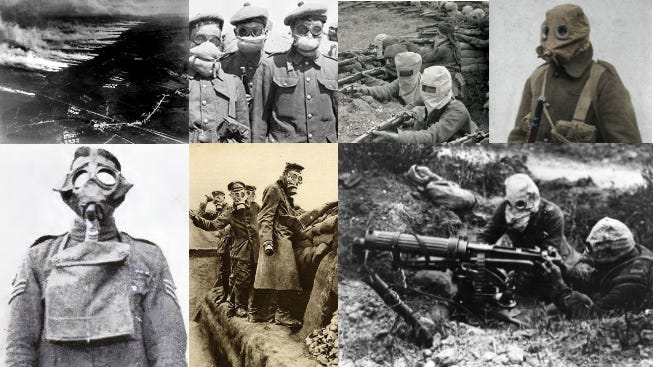
Despite this, the 22nd of April 1915 caught Britain, France and her allies by surprise. At Ypres, southwest Belgium, German forces briefly swallowed the sun with a 10km wide cloud, composed of 160 tons of chlorine gas. This sickly green miasma of death wafted over the French and Algerian Territorial Divisions, who had no idea what was happening. Within moments soldiers were tearing at their throats, the chlorine reacting with the wet linings of their lungs, generating hydrochloric acid. Men asphyxiated where they fell, suffocating as the contents of their bronchi frothed and burbled up onto the mud. Within days Allied forces had ordered their forces to douse cotton pads with sodium bicarbonate, water or urine and hold them over their faces, or stuff them into their mouths. The next few years saw rapid innovations in respiratory-goggle masks adapted for mass use on the battlefield. Cloth masks became initially standardised (Black Veil), then replaced with a sack saturated in chemicals (Hypo & P/PH Helmet) - the idea being that soldiers could just breathe through the cloth weaving and exhale via a metal valve held in the mouth. In 1916 the Small Box Respirator modelled the now familiar idea of inhaled air being filtered through a structure designed to catch and neutralise poisonous compounds.
Each step in this evolution was an agonising trial for the men at the front. Cloths had to be constantly wet, eye pieces fogged up instantly or cracked, sodium phenolate flannel burned when the skin sweated, saliva saturated their faces and chests when mouthpieces had to be gripped by the teeth, nose clips had to be worn - forcing the men to constantly gasp into tubes. All the while battle continued to rage, shrapnel explode and enemies loom up through the smoke. Movement was almost impossible when breathing was so laborious, and early masks were a choice between inhaling poison and suffocating as carbon dioxide levels spiked. The psychological effect of having to don them while hands trembled and straps got caught was unbearable, and panic often ensued even when they were safely hooded - the claustrophobia and loss of sense input might push a frightened man into a complete frenzy, tearing off the hated mask, screaming even as the fog of Phobos descended. Invisible phosgene mixed with chlorine, a wave of chloropicrin inducing vomiting, a third round of bis 2-chloroethyl sulfide - could you survive this while fixing bayonets, the enemy stalking across no-man’s land?
WW1 Madness: Berserker Trench Raids & Gas Attacks in the Tunnels
World War One already summons to mind post-apocalyptic wastelands of mud, craters and callous death, but there were many more strange and terrifying aspects that get far less attention. Trench warfare might be despicable to imagine, but what if your platoon was ambushed during the night by a masked gang? One wearing metal plate armour, cloaks and furs, armed with nail-studded clubs, medieval flails and spiked knuckledusters? As above, so below - the extensive, mind-boggling expanses of tunnel systems below the battlefields were filled with caged birds and skirmish parties stabbing each other in the pitch black, injections of chlorine gas and acrid smoke.
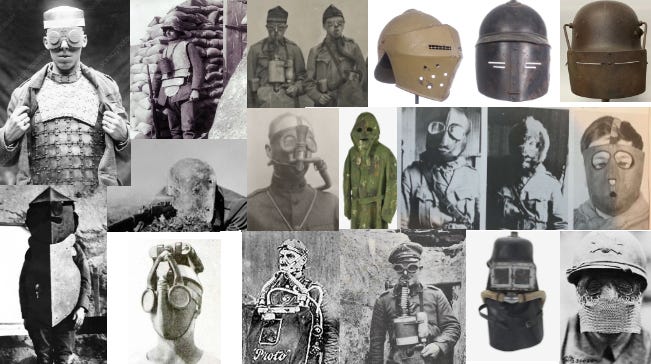
Masks of every conceivable kind exploded during and after the First World War: masks for doctors and nurses, gas masks, oxygen respirators, smoke hoods, anti-frostbite masks, aviation and pilot masks, sniper face shields, full-body armour, anti-shard goggles, the tank ‘splatter’ mask with chainmail, recreations of medieval helmets, flameproof hoods and more besides. Soldiers, engineers and miners working in the tunnel systems below the trenches were at constant risk of carbon monoxide poisoning, accidental fires, enemy mines, ceiling collapse and breakthrough raids from the other side. Miners exposed to low levels of oxygen or excess poisonous gases (including enemy attempts to flush them out using acrid smoke, chlorine or other lethal chemicals) were in need of rescue. The British ‘Proto’ Men, kitted out with one of the earliest self-contained oxygen breathing systems, would have roughly two hours to find them.
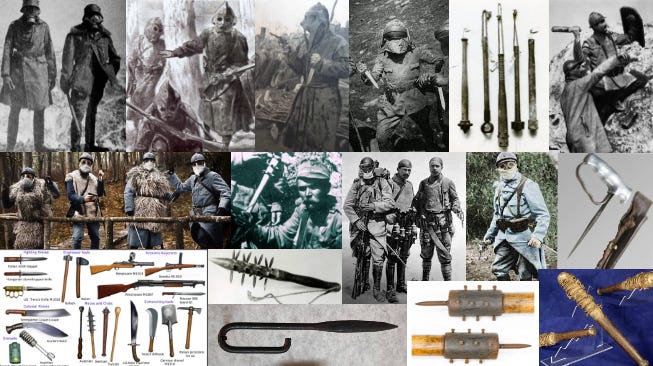
Defensive stalemate was the norm for most soldiers, but some were selected to form aggressive units of trench raiders. These began as relatively ad hoc, almost feral groups of men leaping into enemy trenches in the dark, armed with clubs and axes, dragging away screaming prisoners into the night. Soon their effectiveness became apparent - reconaissance, intelligence capture, prisoners, terrifying the enemy and boosting group morale - raids slowly became formalised into doctrine. The Canadians emerged as masters of the craft, groups of lightly-commanded friends who sometimes ignored orders and enjoyed the dash and adrenaline of raiding. The Germans developed the elite unit concept of the ‘shock’ or ‘storm’ troopers. Both images have persisted into popular culture, one a gang of ‘Mad-Max’ crazies, with improvised weapons and unique disguises, the other a regimented unit with specialised weaponry and formal roles. In a war of dehumanisation and little agency, trench raids with their eclectic mix of shields, body armour, gas masks, hoods, swords, flails, maces, shotguns, shanks, brass knuckles, ‘flash-bang’ style grenades and use of frightening facial appearances, were a temporary outlet of animal spirits. I haven’t seen this argument made anywhere, but it seems likely that this high-low technological melee style combat in the hellscape of the trenches became a primary template for later stories and aesthetics.
To distinguish between the unpleasant (tear gas and the chlorarsines) and the lethal (chlorine, phosgene, and mustard gas) took nerve and training. Indeed, chlorarsines caused short-term but intense respiratory distress designed to disable temporarily but also to terrify.
Colonel Soltau emphasized the importance of chemical weapons in the genesis of ‘nervous disorders’: there ‘is nothing more liable to cause panic than the idea of being choked … the dread of being slowly strangled’
-Terror Weapons: The British Experience of Gas and Its Treatment in the First World War (2016) Edgar Jones
Anxiety, subversion, dread (1919-2025)
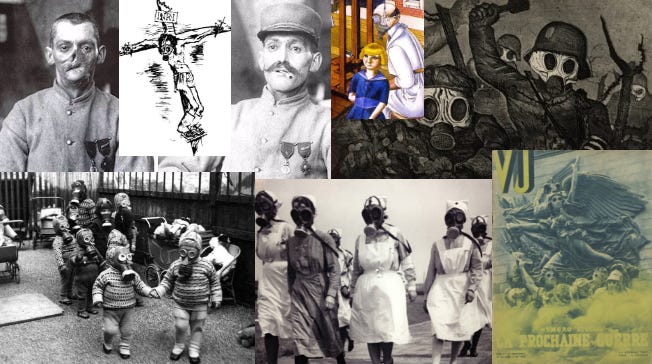
Post-war society in western Europe was shattered by 1919. Many soldiers survived, who would have otherwise died from head trauma. But the cost was unbearable, the horrific disfigurements reducing their children to screams. Mirrors were banned, veterans shut themselves away. One anonymous soldier wrote, in a poem from the Craiglockhart War Hospital, “on my tomb would be this curse, to be stared at”. At the same time as facial prosthetics rapidly advanced for these poor souls, artists began to show the fracturing of the human face, and the role of the mask. Otto Dix, George Grosz and the Neue Sachlichkeit painters used the gas mask as a symbol of terror, alienation, social hypocrisy. Modernisation required faceless men, bureaucratic and contained, the face attaching itself to the mask. Dadaism mocked the powers-that-be, using grotesque and primitive masks alongside the gas mask. As author Hugo Ball said of them - they were “the horror of our time, the paralyzing background of events, visible”.
As direct experience with poison gas was confined to veterans, and as the population had to prepare for potential gas attacks on civilians - the gas mask moved from its visceral, first-hand symbol of utter terror and confinement, to a symbol of anxiety and dread. Science fiction, social magazines, propaganda all used it to great effect. The British re-arming and civilian preparation campaigns normalised uncanny images of children, babies, whole families wearing gas masks. How fast can you get your mask on and get to the shelter? Are you sitting comfortably? Children carried them around their necks and shoulders in small cases, young children had special Mickey Mouse masks, or decorated them with felt and colours. Pictures of nurses, police and air wardens, school assemblies and entire factory floors quietly wearing their masks, produced a feeling of mass de-personalisation, but also solidarity. As with COVID, preparing a nation for mass masking requires provoking fear, and it resonated long after the second world war officially ended. Children continued to wear them for fun, adults carried them around or stored them under the bed and in the attic. The psychological fear and panic of bombs, gas, fire and eventually nuclear weapons, led many to keep them close-by, a long tail of control against the disorder of modernity. No longer just a battlefield tool against gas, the masks (internally, to the wearer) were a symbol of safety - and paradoxically a symbol of authority, blank insect gazes and impersonal violence (externally, to the observer).
As for the British so for the Germans, the new improved military gas mask (S-Maske) was redesigned for mass civilian use (theVolksgasmaske) during the Third Reich. Japan and France underwent a similar process. However, German research and attitudes towards chemical weapons and masks went much further than defence. Through organophosphate pesticide research, German chemists developed the first extraordinarily powerful nerve agents (Tabun, Sarin and Soman). These compounds possessed god-like powers to administer pain and death. Just a few milligrams of them would kill a man stone dead, every muscle fibre in his body firing uncontrollably, every orifice slack, unable to breathe as his diaphragm stopped responding. Manufacturing them was horrifying enough, using them was an ultimate expression of inhumanity, and gas masks were largely ineffective against them. The projected image of the Nazi stormtrooper wearing a modern rubberised hazmat suit complete with a gas mask and gloves remained an ideal within the SS inner circle, and it stayed that way. Poisonous gases were made and tested on a wide scale during WW2, reaching their global apotheosis on civilians, but their use in combat remained limited. The gas mask was for all.
Since the development and proliferation of nuclear technology, novel nerve agents and biological weapons, gas masks have lost their mass existential symbology. There is little point owning one for protection against an external threat, and modern uses are largely specialised: riot police, industry, scenes of terrorism, research labs. Culturally however the gas mask has evolved and continues to evolve. Its smooth, rubberised surface has lent itself to experiments in colour, texture, surface and compression. The total sensory deprivation when placed over the face makes wearing them a unique sensation, while seeing a person wearing one instantly anonymises, dehumanises and elevates the eyes and mouth far beyond normal proportions. Like with all masks, they have been used subversively and playfully - in political subcultures and protest movements (80’s punks, Hong-Kong, Banksy art, anti-pollution campaigns), erotic fetish play, dance/rave cultures and for aesthetic sub-genres (steampunk, dieselpunk). The inner and outer subjective experience of gas masks has remained central to their relevance ever since WW1, and we will now turn to how they have become the ultimate horror mask.
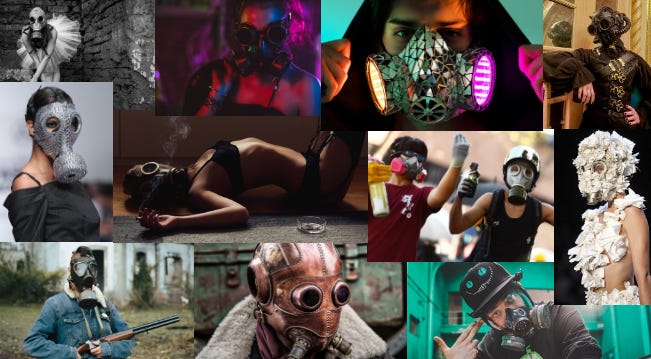
we went down into these troglodyte dwellings where good men who have bidden farewell to worldly things, did their ‘dirty work’ with the ingenuous, childish and methodical spirit of Benedictine monks. We saw the monstrous, grotesque masks of the gas masks, those fearsome goggled snouts which men with such paternal, such gentle faces, so ill-fitted for war, adjust with all the care demanded by the insidious poison.
-Jacques-Emile Blanche, 1916
Turn to Horror: TV, film, games, online
On May 21st 2005, British viewers of the television series Dr Who were introduced to an unnerving WW2-era two-part episode, where the ostensible villain was a small frightened boy. Wearing a large gas mask and sporting a shrapnel wound to his hand, this ‘empty child’ roamed London, terrorising people with his power to control technology and his simple catchphrase “are you my mummy?”. As the Doctor unravelled the mystery, we learn that the little’s boy’s appearance and injuries are spreading like a virus, transforming any sufferer’s face in a scene of horrific transfiguration - the respirator filter sprouting from the distended mouth, halfway between a retch and jaw dislocation, the eyes bugging and goggling over, smooth rubber literally becoming a new, fused skin, the personal identity of the wearer gone. Replaced with a robotic algorithm, empty and hollow.
Gas masks in horror amplify what we already feel about them: our inability to read an expression or even see the eyes, the unnatural exaggeration and simultaneous smoothness, the implication that something is wrong with the surroundings but they are in control of it, a ‘chemical subject’. A lone person wearing such a mask is even stranger, a juxtaposition that feels menacing and threatening. The slasher Harry Warden from the two My Bloody Valentine films, known as The Miner, silently wields his pickaxe against transgressors, his eyes hidden behind reflective goggles. The Surgeon from Hellraiser’s Stygian Inquisition silently carries out the sentences of mortals, dressed in a black leather bodysuit, chainmail apron and black gas mask - an outfit of hygiene and terror, with the lurking implication that they take some sensual pleasure in their craft.
The gut dread that something not quite right is behind the gas mask is another twist of this horror style. The creepypasta gas masks and cornfields being is an empty mask filled with insects; the Snorks from the game S.T.A.L.K.E.R; the relentless things of Wyrmwood. Within analog horror stories the gas mask silhouette and eye pieces stare out of found footage or old camera reels, invoking paranoia, dread, the resurrection of old ghosts. Gas masks in The Purge franchise, by contrast, play with its counter-cultural, protestor, raver usage. LED patterns, youthful hoodies and the addition of wigs reflect its self-concious use in the Purge universe as an intentionally anonymous, frightening and disturbing mask.
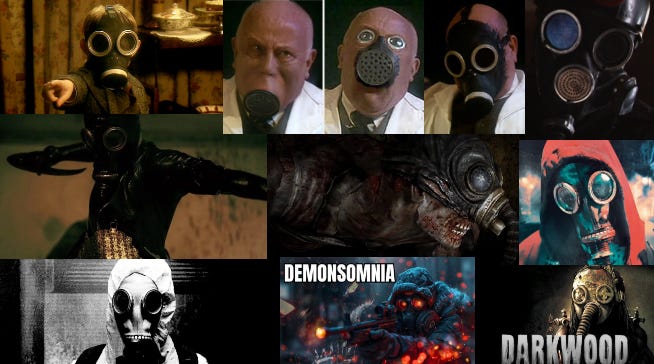
Reflecting the inner experience of the gas mask - films and games where the protaganists and players have to wear them, in order to survive their environment and to build an historical or dystopic feeling. Empty Shell, Metro 2033, Demonsomnia, The Last of Us, Darkwood, Tenet, Contagion, Chernobyl and many more explore post-apocalyptic or historical worlds, where respirators are needed. Dramatic or horrfying moments are made that much worse when only the eyes can be seen through the lenses, or muffled screams drowned out by the filter. A final and obvious version of this type of media are films and games set in WW1 and WW2, which either intend to portray the reality of the combat, or use the masks to invoke that terror, which we today can only have read about. These include: All Quiet on the Western Front, Trench 11, Overlord, CONSCRIPT, Trench Crusade, Trench Tales, Ad Infinitum and Amnesia: The Bunker. The 2021 film The King’s Man has a wonderful combat scene in no-man’s land at night, between British and German soldiers. Both sides agree not to use weapons, to prevent escalation, and hand-to-hand combat begins - the Germans fulfilling the Junger-esque dream of a modern knight, with gas masks blending seamlessly into a medieval skirmish. A final mention must go to the ‘Nazi zombie with helmets and gas masks’ trope from countless splatter and comedy games/films - the mask-as-face/face-as-machine blending together.
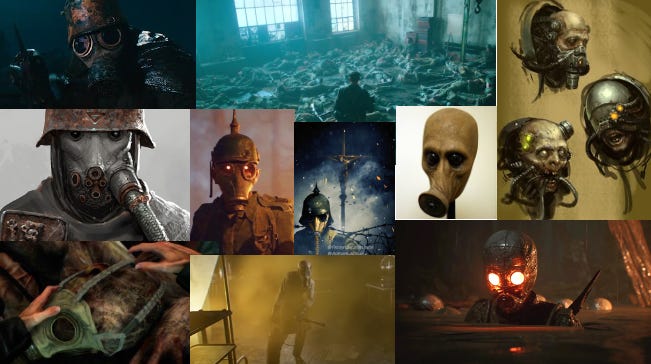
The new soldier was a whole new breed, embodying energy and loaded with the utmost force. Smooth, lean, sinewy bodies, striking faces, eyes petrified in a thousand horrors under the helmet
-Jünger, Der Kampf als inneres Erlebnis
The mask as involuntary face
Horror is obviously associated with actions that people did not want to experience, and several masks get to play a key role in this narrative. Medical masks will be explored in a separate article, but gas masks are unique because they afford the wearer some genuine protection and isolation from the outside world, survival. Sometimes this becomes a necessity, as with the character Bane from Christopher Nolan’s Batman films, and most famously with the iconic Darth Vader of Star Wars.
Vader is easily the most famous use of the gas mask silhouette in film, perhaps in all media. His striking black suit, gloves, cape, helmet and mask radiate terror and fear. But when one strips away the scifi-opera theatrics of Star Wars, the story of Anakin Skywalker’s rise and fall is genuinely horrific. His gruesome and excruciating disfigurement-as-punishment and compulsory life support system portray body horror, claustrophobia and the power of the face/mask dualism almost like no other. Vader’s costume design drew explicitly from Japanese and German sources, including a gas mask.
In Summation
My argument, that the gas mask represents the horror of modernity, and has become the ultimate symbol of modernity within the horror genre, seems obviously correct to me. A mask that provokes so many emotions, both in the wearer and observer, that has come to symbolise so many aspects of modern life, stands out from the horror crowd. Gas masks are:
Alien, smooth, insectoid, bizarre, second skin
Mechanistic, industrial, survival
Dehumanising, anonymous, beaurocratic, procedurial
Menacing, threatening, violence is not far away
Psychological aids, crutch, comfort
Panic inducing, sensory deprivation, heartbeat-in-your-ears
Nostalgic, paranoia, dread, analog familiarity and fear
Playful, erotic, amusing, funny, sensual
Rebellious, energetic, movement, vitality, speed
They could be considered almost serene, in the ‘southern serene’ sense of my first article, due to their blank, symmetrical and smooth appearance. But I think ultimately, their monstrous distorted visage and hybridity between flesh and synthetic machine makes them a modern ‘northern numinous’ mask. Terror, violence, the eruption of huge eyes through gas, transformation and fear inside and out, mask as portal, hyperventilation and asphyxia, sweat and mist blinding the glass - a torture chamber for the psyche attached to your face, a parasite of modernity.
If you enjoyed this work please consider a paid subscription or browse my books on Amazon. I always aim to write high quality articles covering the macabre and darker sides of anthropology and archaeology, as well as coverage of contemporary science topics and my own personal takes on philosophy, history and art. Your support really helps me continue this project, thank-you!
Great topic. This mask series is really, really interesting. Thank you very much for it.
Upgraded to paid for this: excellent placement of the paywall there, how could I not read on at that talk of fur-clad flail-wielding trench berserkers!
Re gas mask use in modern culture, an interesting edge case might be the space jockey in *Alien*. The gas mask dominates its “look,” but for me at least its impact is not dehumanising: there’s a sort of ruined nobility there, perhaps because the breathing tube looks like an elephant’s trunk (that noblest of beasts), perhaps because the creature is so obviously long dead, perhaps also by way of contrast, the invocation of a WWI aesthetic amidst the 80s corporate/industrial setting…