

In 1783 the Laki volcanic fissure in Iceland began spewing out millions of tons of hydrofluoric acid and sulphur dioxide, darkening the sky. The fire and lava was dramatic, but it was as nothing compared to the fluorine - settling invisibly on the grass - the sheep jaws swelled and their bones went soft and they died in the fields. Half the livestock in the country perished, but people ate the poisoned carcasses anyway, then their leather, shoes, animal harnesses, boat-rope. Somewhere between a fifth and a quarter of the people on the island died, almost none of them from the fire. At Kirkjubæjarklaustur a priest named Jón Steingrímsson walked his congregation into the church as the lava came down the valley and preached until it stopped. The sermon is still called the Eldmessa, the Fire Mass, and the famine called the Móðuharðindin, or Mist Hardships.
The volcanic haze went south, and by late June it lay across Europe - a dry unpleasant fog that burned the eyes and lungs of anyone working outdoors. Gilbert White in Hampshire called it unlike anything within the memory of man. Labourers went on working through the harvest and collapsed in the fields, Britain’s dead soared to perhaps twenty-three thousand. In a garden at Passy, working on the treaty that would end the American war, Benjamin Franklin looked at the fog and inferred it was the work of a volcano, in Iceland, and that a bitter winter was going to follow.
The Chesapeake froze up to its mouth, ice ran a hundred miles into the Gulf of Mexico. Alaskan tree rings dropped four standard deviations below their mean, and the Kauwerak remembered it as the summer that never arrived. Unfortunately 1783 was also an El Niño year that paired with a negative North Atlantic Oscillation. The same year also saw the Nile failing to rise. Volney, a friend of Franklin’s, recorded that much of the famous Egyptian farmland went to weed for lack of water and want of seed - the seed had been eaten. By January 1785 a sixth of the valley was dead or had fled.
India and Japan were already in dire straits before the fissure opened. The Chalisa famine had emptied the Doab, with whole villages abandoned as people simply walked off the land. Eleven million people had died over the past two years, while the East India Company looked to Bengal, which had already lost a third of its people to hunger over a decade earlier. In Tōhoku the rice yield had been progressively worse for years. Mt Iwaki then erupted in April, then Mt Asama in August, producing massive pyroclastic flows and dropping ash as far as Edo. The villagers in Tsuguru ate weeds, then straw, then each other - ultimately losing near half its people. Sugita Genpaku, the physician who revolutionised Japanese medicine by translating a Dutch anatomy book, estimated the national dead at twenty thousand - modern estimations put the full toll of the Great Tenmei Famine at near one million, when the handmaiden of all famines is accounted for, the spread of disease.
None of these starving farmers and labourers could have known anything about each other. The Icelander eating his poisoned sheep, the Egyptian watching the dying river, the family fleeing their land in the Doab, the Tsugaru household contemplating the ultimate taboo. Each catastrophe was local, explicable by God or the shogun or the Company, or maybe it was just bad luck.
For nearly all of human history, eternal cyclical hunger was the baseline condition of life. Bottlenecks, episodes of cannibalism, cave paintings of animals that vanished from the fossil record. Today we are aware of this, in a sense, but we cannot empathise or feel the same bond since we are blessed with the most anomalous of circumstances, abundance of all things. We are wired as animals to be driven by food, finding food, a preference for the rare high calorie gifts. We are the first civilisation to have solved the persistent problem of daily, annual, seasonal hunger. Thanks to the British Agricultural Revolution, the discovery of the Haber-Bosch process, Norman Borlaug’s dwarf wheat and an unfathomably sophisticated set of global supply chains - most people in most places are not starving.
A consequence of this is our unfamiliarity with true, ravenous hunger. We no longer know the internal feeling, and whilst we might occasionally miss a meal, or even be unfortunate enough to slide into homelessness or worse, we do not experience the collective sensation of seeing our crops fail, livestock die and water run dry. We do not have to make the choice of eating the seed corn, an idiom passed down to us as the ultimate choice to sacrifice the future for the present. We also don’t know the fear of starvation, of what it will do to a person, or a society. When it grips hard, men will do anything for a morsel, and all bonds of human fellowship and custom evaporate, leaving just man the animal.
What we do have though is unique, access to all available information about famines and hunger throughout the world, and we should read it and learn from it. First-person testimony from these famines, sieges, droughts, wars and even controlled experiments all point towards the same end: sustained hunger dismantles personhood itself, collapsing all thought, all morality, memory, sexuality and familial feeling down to one absolute overwhelming drive, before it finally kills.
The well-fed have always found the sight of the starving to be utterly unbearable, and observers across cultures and times describe how only a thin veneer separates the full from the dying. Civilisation can only be built and maintained within this narrow margin. Many cultures that had to live with threat of starvation left us a fossil record of myth and legend, warnings and stories such as the Wendigo, Erysichthon, hungry ghosts - insatiable beings that encode both the phenomenology of crazed hunger and the extreme danger a starving person poses to everyone around them.
The question ‘what does it feel like to starve’ is hard to answer fully, but the single most valuable body of evidence is the Minnesota Starvation Experiment. This was conducted at the University of Minnesota between November 1944 and December 1945 by the physiologist Ancel Keys (designer of the army K-ration) and published in 1950 as the two-volume The Biology of Human Starvation. Thirty-six healthy male conscientious objectors, screened to exclude anyone with prior mental illness or food problems, were fed roughly 1,570 calories a day, divided between breakfast and lunch, during the 24-week semi-starvation phase, about half their needs, on a diet meant to imitate war-torn Europe (potatoes, turnips, macaroni, dark bread). On top of this they walked roughly 22 miles a week.
These men were the opposite of desperate when they arrived at the university. All fit and healthy, morally idealistic, many of them religiously minded, all of them committed to the experiment, an experiment which had a fixed finish point. Despite these factors, they still came apart psychologically. Keys’s team coined the term ‘semi-starvation neurosis’ to describe what they saw, both during the hunger period and the rehabilitation period. On the Minnesota Multiphasic Personality Inventory, the men showed marked increases in depression, hysteria, hypochondriasis. Of the men who completed the study (several were dismissed for sneaking food), five developed symptoms beyond semi-starvation neurosis, for two the response bordered on psychosis - one, identified as Watkins, developed an MMPI profile resembling schizoaffective psychosis before the halfway point.
Their testimony is still fascinating to read today. Harold Blickenstaff, interviewed decades later:
Food became the one central and only thing really in one’s life... if you went to a movie, you weren’t particularly interested in the love scenes, but you noticed every time they ate and what they ate.
Carlyle Frederick collected nearly 100 cookbooks by the end of the experiment. Men dawdled up to two hours over a meal they could have scoffed in minutes, they diluted food to make it feel like more, held each bite in the mouth, licked their plates, used salt and spices to excess and drank a lot of water. Participant Max Kampelman noted:
The sex drive disappeared. There was none.
Interest in friends turned into irritation, Frederick recalled that
Little things that wouldn’t bother me before or after would really make me upset.
Samuel Legg described a troubling moment of pure irrationality watching a boy cycle home to supper:
I was walking along … [with my] buddy … it was deep into the semistarvation, and we were tired … we were standing at a corner waiting for a light or something, and a kid came along on a bicycle, and he was really moving, pumping away … And I looked at him and said, “Wow, look at that boy. He's really whizzing.” And then I said to myself, “I know where he's going. He's going home for supper. And I'm not.” And then for a very brief, I hope it was brief, moment … I suddenly hated the boy … I hate at this point to tell you this, because it doesn't speak very well for me. But I remember … with … horror that I could feel such a thing. So utterly irrational, but there it was. And you ask an experience that I remember; I sure remember that. That was rough.
During the rehabilitation phase Legg chopped off three of his own fingers with an axe while cutting wood. When asked whether he did it on purpose, he said he wasn’t sure if he lost focus, or if part of his mind wanted to escape. Though he was technically in rehabilitation, Legg’s cohort were initially given just 400 additional calories a day. The study leader, Keys, testified to the US government that any civilisational level plan of implementing democracy and such after the war would rely first on feeding the population sufficient food. Ultimately he concluded, starving people don’t care about wider issues like society, politics or even friends and family.
Perhaps unsurprisingly this experimental record matches the testimony from real catastrophes. Knut Hamsun’s Hunger (Sult, 1890), drawn from his own destitution in Kristiania (Oslo), portrays his starving mind complete with euphorias, paranoia, dissociation. At one point the narrator, unable to sleep, sucks his own finger and is suddenly seized by the overwhelming impulse to bite it off.
George Orwell actually went hungry for the writing of Down and Out in Paris and London (1933), describing the feelings of dissociation and fatigue:
Hunger reduces one to an utterly spineless, brainless condition, more like the after-effects of influenza than anything else. It is as though one had been turned into a jellyfish, or as though all one’s blood had been pumped out and luke-wann water substituted. Complete inertia is my chief memory of hunger
He noted that hunger dissolves the normal sensations of time, punctuality and the pressures of the future, preferring to simply not do anything right now - too much effort to worry about tomorrow. His character Boris also delivers the classic line
It is fatal to look hungry. It makes people want to kick you.
In Leningrad under siege (1941-44), the human response was the same. From November 1941 to February 1942, the city’s daily bread ration collapsed to just 4.4oz per person. But it was just the beginning, as this ‘bread’ was cut with more and more filler materials - sawdust, powdered wood, cellulose - leaving many surviving on just 300 calories a day. Leningrad’s suffering was recorded through its diarists, who contradicted the medical knowledge of the day by writing matter-of-factly about ‘hunger psychosis’
The siege diarists wielded “hunger psychosis” liberally as though it was a common affliction. Even young children, the journals suggest, learned to identify and diagnose it… she meticulously chronicled her father’s crippling delusions, which also included— like Sedel’nikova’s— images of devouring oneself:
He has been diagnosed with Stage III distrofia, the cachectic kind (I don’t know what that means, but they say that it is the worst kind of distrofia, from which it is impossible to recover, even through healthy food). He is really just terrible. He is completely withered, his face is yellow and puffy, and his eyes are glazed. Above all, he is completely changed through and through; he has become deranged. All day he lies around [. . .] indifferent to every thing. Or he begins to cry or scream from hunger and says that he will eat kindling, that he is prepared to eat himself. His voice rings in my ears, “Give me something to chew on! Give me something to chew on!” [. . .] Sometimes he starts saying all sorts of absurd things: “Where is my body? I don’t know what happened to me. I don’t understand what’s going on with me. Where is my body?” It is difficult and also irritating to look at him. This is not Papa, it is simply not him— this is a dirty, lice infested, half- insane person, almost not even a person.
-The War Within - Diaries From the Siege of Leningrad (2017) Alexis Peri
The Siege of Leningrad lasted for an agonising two years, four months and nineteen days, and caused the death of over a million Soviet citizens. The majority perished from starvation and disease, aided by freezing temperatures and relentless bombardment. It remains the most destructive and likely the most lethal city siege in human history, and suppression of its worst details by Soviet authorities has meant we are still learning of the terrible conditions Leningraders had to endure.
In the Warsaw Ghetto, a group of Jewish physicians led by the dermatologist Izrael Milejkowski studied starvation clinically even while they were starving themselves. When the Ghetto was liquidated, the doctors managed to collate and preserve their work, dubbed the ‘Hunger Disease’ studies, which was later smuggled out and published. Emil Apfelbaum, one of the imprisoned doctors, wrote:
The organism which is destroyed by prolonged hunger is like a candle which burns out: life disappears gradually without a shock to the naked eye.
This study remains invaluable, since it is impossible to replicate the conditions of the Ghetto under any experimental standards. The detailed and meticulous records the doctors made revealed the straightforwardly brutal pattern of long-term caloric deficit on the human body - first the metabolic system adapts and slows down, bringing activity to a near halt to conserve energy. The body burns through its glycogen stores (liver, muscles), then its fat reserves, finally it begins stripping protein from the organs themselves. The damage to the circulatory system was lethal if starvation had gone on too long - weakened capillaries and tissues leaked fluids, causing edemas and dropping blood pressure, the heart muscle itself degraded for fuel. The doctors were able to show that re-feeding a starving person required careful evaluation beforehand, that loading food into someone with a compromised heart and organ damage would quickly overwhelm and kill them.
A recurrent theme across cases of famines and sieges is that hunger steadily dismantles the moral person, then it kills the biological one. Chroniclers of the Great Famine of 1315-1317 in northern Europe described this sequence thus: first the slaughter of draft animals, then the eating of the seed grain, next leather and shoes, the reported abandonment of children and finally the troubled accounts of cannibalism and grave-robbing. The city of Bristol’s civic chronicle for 1315 recorded
a great Famine of Dearth with such mortality that the living could scarce suffice to bury the dead, horse flesh and dogs flesh was accounted good meat, and some eat their own children. The thieves that were in Prison did pluck and tear in pieces, such as were newly put into prison and devoured them half alive
-Bristol Archives transcription, manuscript 09594/1
The dissolution of shame is a frequently noted marker of extended hunger. Josephus, an eyewitness of the Roman siege of Jerusalem in 70 AD, wrote that
It was now a miserable case, and a sight that would justly bring tears into our eyes… the famine was too hard for all other passions: and it is destructive to nothing so much as to modesty; for what was otherwise worthy of reverence, was in this case despised. Insomuch that children pulled the very morsels that their fathers were eating out of their very mouths: and, what was still more to be pitied, so did the mothers do as to their infants. And when those that were most dear were perishing under their hands, they were not ashamed to take from them the very last drops that might preserve their lives. … when they saw any house shut up, this was to them a signal that the people within had gotten some food. Whereupon they brake open the doors, and ran in, and took pieces of what they were eating almost up out of their very throats, and this by force. The old men, who held their food fast, were beaten: and if the women hid what they had within their hands, their hair was torn for so doing… they lifted up children from the ground, as they hung upon the morsels they had gotten, and shook them down upon the floor.
His account of Mary of Bethezuba, a well-born woman driven by starvation to roast and eat her own infant became infamous across later Christendom. The public nature of her act, offering to share her ‘food’ with the combatants, shamed the Jewish insurgents - many of whom had robbed and stolen food from their own people during the siege.
The pattern repeats itself in every modern famine. In the Holodomor (Ukraine, 1932-33), survivors describe swollen bodies in the streets, the disappearance of dogs and cats, people eating grass, tree bark, acorns, earthworms, mice and cannibalism.
“One old woman ate her child,” Mariia reveals. “The woman was old, but she did eat her baby. That’s how it was in 1933. It stays forever with you, it is engraved in my mind forever. That woman survived, but she didn’t live long. Her niece took the woman to her house and reproached her: ‘You did eat your child’”
-Account of Mariia Andriivna Tilna, Holodomor Museum Archives
In the Great Leap Forward famine (China, 1959-61), Yang Jisheng’s Tombstone documented villages stripped of bark, people eating soil and seeds sifted from animal dung. Cannibalism was reportedly widespread, human corpses rotting where they fell since the cats and dogs and available wildlife had already been eaten. Yang concluded that at least 36 million people starved to death, other journalists and researchers have estimated higher.
Many cultures exposed to recurrent starvation distilled the experience into figures of terror, supernatural horror and warning - insatiable, ravenous beings. These monsters encode both the phenomenology of an endless hunger and the social danger a starving person poses to family and neighbours.
An obvious example is the Wendigo/Windigo of the northern Algonquian peoples - the Ojibwe, Cree, Innu etc. Here in the brutal forests of North America winter starvation was an annual killer and the Wendigo is described almost like a mythic transcription of reality. The monster is emaciated, gaunt, with a heart made of ice, perpetually ravenous but eating can never satisfy it. Some say it grows in bulk as it eats, remaining forever as starved as before. The Wendigo is not truly a predator from outside the band, although it acts like one. It was someone previously inside the group - a hunting partner, a parent, a child, then hollowed out by a bitter winter, forced to the eating of human flesh. Man’s warmth is primate solidarity, the Wendigo is a lesson that hunger can undo even this, breaking ties with a heart of ice. In societies where food-sharing is a foundational moral institution and survival necessity, an insatiable eater is a dangerous defector. Someone who eats alone, eats more than their share, even eats their own - this is a social monstrosity - but a monstrosity which lurks in everyone. Under the right conditions, anyone could become that defector, anyone could turn on their loved ones, driven out of their minds and conscience with hunger.
Ancient Greek tradition has its own version in Erysichthon of Thessaly. He foolishly cuts down the sacred grove of Demeter and the goddess sends a mountain nymph to summon Limos, the personification of hunger. Limos appears as a gaunt woman trapped in a frozen wasteland, clawing at dying grass with her nails and teeth. Limos (or Fames in the Roman tradition) appears to the sleeping Erysichthon and breathes herself into his veins. He wakes ravenous and begins to eats without end, consuming his whole estate, selling his own daughter for food. With nothing else left, he then devours his own body limb by limb. Self-consumption as the brutal final act of insatiable hunger is not unique to the Greeks, the same idea was reached by the Chinese, depicted by the bronze masks/faces known as taotie (饕餮). Tradition holds that such a creature, inflicted with ceaseless gluttony, must eat its own body until only the head remains.
The other well known monster is the hungry ghost: the Indian preta, the Japanese gaki, the Chinese egui, well described in Hinduism, Tibetan Buddhism, Taosim. These beings from the realms of endless desire are sometimes depicted with a vast, swollen belly, a mouth or throat no wider than a needle, tormented by a bottomless appetite. Frequently the unhappy fate of the greedy and the miserly, those who in life hoarded food or refused to share. An entire ritual calendar exists just to relieve them, such as the Obon festival and the segaki rites of feeding the hungry ghosts. We must share food, lest we too one day suffer the same fate.
The Finnish famine of 1866-68, suuret nälkävuodet, the ‘great hunger years’ deserves to be better known as the last major famine of natural causes in Europe (along with the parallel Swedish famine of 1867-69). Nearly 10% of Finland’s population perished, some 270,000 souls over three years as the weather seemed to actively turn against the people. The mascot of that famine is pettuleipä, bark bread, made from the inner cambium layer of Scots pine. This material is harvested in spring when its nutrient content peaks, then dried, roasted to drive off the worst of the resins, pounded to dust and mixed with whatever rye flour there is to hand. Bark bread had been eaten during Finland’s Great Famine of the 1690’s and it was a regular food for the nomadic Sami. But in the 1860’s it became the taste of national catastrophe - a bread that does not rise and barely holds together, made from a tree. Three surviving pieces of it can be seen in the Helsinki university museum, preserved by one Dr von Collan. Today one can find many artisan sourdough breads on sale which incorporate acorn, birch and pine bark - traditional famine foods turned flavour curiosity.
The list of famine foods across the whole miserable record is itself a testimony to the ladder of necessity as hunger begins and then continues. In medieval Europe we know of roots, grasses, nuts, bark, then dogs, cats, leather hides and shoes, dirt and dung, then finally the dead. The Irish record adds seaweed (dulse, Irish moss) nettles, wild mustard, sorrel and donkeys (the ‘Donkey Aters’ of Skibbereen). In Leningrad they ate bark, glue taken from wallpaper, sawdust and boiled leather. The staff and researchers at Ivan Pavlov’s famous Physiological Institute turned on his dogs, who were all eaten during the siege. Incredibly the scientists in charge of the Soviet Pavlovsk Experimental Station remained committed to protecting the thousands of rare tubers and grain seeds in their gene bank collections, dying of starvation rather than consuming the precious plants.
What counts as an initial famine food is determined by culture. Human societies never eat everything they can find when times are good, but use complex rules of taboos, status, gender, age and religion to demarcate what should and should not be eaten and when. Fresh roadkill is often perfectly safe to eat, but it would not be considered a polite food to serve guests or bring to the office for lunch. When famine or war hits, one of the first thresholds to be passed is the cultural gate, followed by the unspoken proscriptions on zoo animals, pets, wildlife, insects and vermin, then barely edible plants such as flowers and sycamore seeds, other materials such as cattle feed, then the craft supplies of glue, pulp, engine lubricant, machine oil, paint, thatch, pottery clay and sawdust - to name just a few. The Dutch Hongerwinter famine of 1944-45 is well known for people turning to tulip bulbs for survival. Medical research in celiac disease before, during and after the Dutch famine is interesting to read about, as is work done on the Dutch famine birth cohort, which tracked epigenetic and health changes to children who were in the womb during that winter period.
What people will eat during extended times of hunger shows clearly how individual and collective social behaviours are stripped away, bit by bit, as norms and expectations, ethical obligations, kinship bonds progressively fail in the face of caloric deprivation. Likewise what people will do fir sustenance follows a similar course - selling possessions and heirlooms, prostitution, begging, stealing and robbery, selling children or oneself into bondage or slavery, performing degrading and humiliating acts or types of labour, selling one’s organs, assault, murder and cannibalism. For observers, witnessing this kind of collapse in dignity and familial ties is deeply disturbing and troubling. Man the sapien, reduced to Man the animal, the beast. Such a creature has no loyalty to the polis, city, community, village, tribe or nation, they cannot be expected to hold the line in a battle, nor keep the gates shut against the enemy. History records the many sad fates of besieged civilians: the 1204 siege of English-held Château Gaillard by Philip II of France saw non-combatants expelled from the castle as ‘useless mouths’ and prevented from crossing French lines, effectively trapping them without food in no-man’s land; the mind-boggling story of General Zhang Xun and the 757 Siege of Suiyang, where the civilian population was eaten by defending troops in order to maintain their resolve; Josephus recorded how the Romans encircling Jerusalem would torture and crucify any who escaped from the city or threw themselves on Roman mercy
the severity of the famine made them bold in thus going out.. after they had fought, they thought it too late to make any supplications for mercy. So they were first whipped, and then tormented with all sorts of tortures, before they died; and were then crucified before the wall of the city. This miserable procedure made Titus greatly to pity them; while they caught every day five hundred Jews; nay some days they caught more. Yet it did not appear to be safe for him to let those that were taken by force go their way; and to set a guard over so many he saw would be to make such as guarded them useless to him. The main reason why he did not forbid that cruelty was this, that he hoped the Jews might perhaps yield at that sight, out of fear lest they might themselves afterwards be liable to the same cruel treatment. So the soldiers, out of the wrath and hatred they bore the Jews, nailed those they caught, one after one way, and another after another to the crosses, by way of jest. When their multitude was so great, that room was wanting for the crosses; and crosses wanting for the bodies.
-The Jewish War, Bk V Ch 11, Flavius Josephus
For the whole of the Pleistocene survival depended on the fluctuating success of hunting, fishing and gathering. No doubt many times were good, and modern hunter-gatherers show us how their knowledge of their environment and seasonal changes create great breadth of food redundancies and reserves. However, natural selection certainly seems to have favoured the traits we call disorders of abundance in modernity: incredibly efficient fat storage to fuel a metabolically expensive brain, mechanisms for overeating, frequent eating, eating in the absence of need. These are adaptive in a world of feast-and-famine, but hazardous in today’s world of reliable supply. It stands to reason that our ancestors were not starving every day, but were biologically driven to eat as much as possible when food was available. Herbivorous grazers eat constantly, but grass is appallingly low in nutrition, so their appetite is justified. Rats maintain their body weight on standard rodent food, but become rapidly obese on high-calorie foods. Labradors and humans may share a genetic mutation which blunts appetite suppression, leading to constant and habitual eating, despite being physically full.
We can also tell from the opposite lens how difficult it is for human beings to control their appetites when confronted with food, especially highly palatable and sugary, salty, fatty foods. If left alone in a room with a table full of pizza, chips, desserts and the like, most people will eventually give in and eat some. Controlling one’s appetite is a traditional test of self-control, self-discipline, managing impulses and cravings. To be on a diet, to fast, to go on extended fasts - these are markers of willpower. Willpower can be aided by social reinforcement, status, rewards, fear of stigma and punishment, but ultimately controlling one’s intake of food - whatever the regime - demonstrates the inbuilt drive human primates have toward feasting.
A partial timeline of famines and starvation
A full list of human famine would be impossible, even a partial list would take a lifetime. I’ve selected a sample from across the span of history and geography, causes and results. Famines are rarely studied relative to war or other forms of mass mortality, and yet the figures reveal the vast scale of starvation, interlinked with conflict, disease, climate, weather, governance and sheer misfortune.
Ancient and medieval
Ancient Egyptian famine of 2180 - 2130 BC. Severe drought led to crop failures, starvation recorded on Ankhtifi’s tomb, likely the earliest famine testimony. End of the Old Kingdom, Upper Egypt was so hungry that people likely ate their own children. Death toll unknown.
Volcanic Winter of 536. Northern Hemisphere. A dust veil caused the coldest decade in two millennia, crop failure recorded in Byzantium, Ireland, Scandinavia and China. Plague of Justinian breaks out. Death toll unknown, estimated in the millions.
The Year of Ashes (Am al-Ramada) AD 638 - 639. Arabia. A 9-month drought leading to widespread famine, during which Rashidun Caliph Umar ibn al-Khittab suspended the Quranic penalty for theft, arguing that a starving man is not a thief. Re-emergence of bubonic disease, Plague of Amwas in Syria. Death toll unknown.
The Yōwa famine (養和の飢饉) of AD 1180 - 1182. Japan. Drought, war and disease led to populations fleeing and bodies piling up on the riverbanks. Death toll in Kyoto alone estimated at over 42,000.
Egyptian famine from AD 1200 - 1202. The Nile failed for two years in a row as rainfall decreased in Ethiopia, food stores ran out. The physician Abd al-Laṭif al-Baghdadi documented it as an eyewitness. People were convicted of eating human flesh and burned alive as punishment, children were targeted to be killed and eaten. 100 to 500 deaths a day in Cairo by Baghdadi’s count.
The Great Famine of 1315 - 1317. Northern Europe. Very high levels of rain in all seasons for several years, crops failed and food prices soared. Famine from Ireland to Poland, height of rural medieval population numbers - not seen again until the 19th century. Communities ate seed grain and draught animals. Infanticide and cannibalism reported. Death toll est. 5 to 12% of population.
Ce Tochtli (One Rabbit) Famine of 1450 - 1454. Valley of Mexico. Frost and drought depleted Moctezuma I’s granaries, Nahua families sold themselves into slavery on the Gulf coast in exchange for maize. The Aztec 52-year calendar linked the year of ‘One Rabbit’ to drought, partially confirmed by tree ring studies. Death toll unknown.
Early modern - Little Ice Age
Russian Famine of 1601 - 1603. Volcanic cooling from Huaynaputina in Peru destroyed three consecutive harvests, crops failed and the temperature plummeted, livestock and wildlife killed for meat and fur. Many sold themselves into slavery or fled to join the Cossacks. Estimated 2 million deaths, a third of the population.
Deccan Famine of 1630 - 1632. Est. death toll 3 to 7 million.
The Gujarat famine began with a drought in 1630, attacks on crops by mice and locusts in the following year, and then excessive rain. Famine and water-borne diseases created high mortality: 3 million died in 1631. People migrated towards less affected areas, many died on the way, and dead bodies blocked the roads. Both Persian and European sources tell the story of this famine, with a subverted cornucopoeia of grotesque consumption patterns: cattle-hide was eaten, dead men’s bones were ground with flour, cannibalism was frequent, and people fed on corpses. Carts belonging to banjaras (carriers) transporting grain from the more productive regions of Malwa were intercepted and supplies diverted to feed Shah Jahan’s royal army in Burhanpur, who were fighting territorial wars in the Deccan (southern) provinces.
-The Travels of Peter Mundy, Vol-I, 1628-1667
French Famine of 1693 - 1694. The worst demographic crisis of the ancien régime, killing roughly one in twenty as the cold weather led to a general wheat crop failure. Est. death toll approx 1.3 million.
The Great Famine of 1695 - 1697. Finland and Estonia. The Little Ice Age continued its reaping, this time the cold summer and early frost ruined harvests across the Swedish empire. Famine, then typhus and other diseases claimed around a third of all Finns and a fifth of Estonians. The first appearance of bark bread as a national diet. Death tool approx 150,000 in Finland, 100,000 in Estonia.
Bliain an Áir (the Year of the Slaughter) 1740 - 1741. Ireland. Everyone has heard of the Irish Great Famine, but a freak two-year cold spell killed a much larger proportion of the population a century earlier and is almost entirely forgotten. Severe frosts and freezing temperatures destroyed not only the harvests, but also the stored grain and seed potatoes for the following year. Hunger led to smallpox, dysentery and riots. Est. death toll 300,000 to 480,000 (around 15/20% of population).
Nineteenth century
Orissa famine of 1866, Na’anka Durbhikshya. India. At least a million died, roughly a third of the Orissa province, after the rains failed to yield the main rice harvest. The Bengal Board of Revenue was misled by fictitious price lists, then only able to send late relief by boat since the province had no railway and the monsoon had cut the roads.
Persian famine of 1870 - 1872. Drought and grain hoarding killed perhaps a tenth of the country, although some have argued up to a quarter of the population died when the subsequent waves of cholera and other diseases are considered. Est. toll of 1.5 - 2 million people.
1877 - 1878 El Niño event. Potentially the worst environmental disaster in human history, the most intense El Niño on record, leading to the North Chinese Incredible Famine, the Brazilian Grande Seca and the Indian Great Famine, amongst others. Maybe 50 million people perished, between 3-5% of all human beings alive at the time.
Kifu Qen (the Evil Days) 1888 - 1892. Ethiopia. An imported rinderpest disease destroyed the cattle on which the entire highland economy rested. Drought then brought worms and locusts, ruining the crops. Under these combined pressures some have estimated up to one third of the population died.
Twentieth century and today
The Great Famine of Mount Lebanon. 1915 - 1918. An Allied naval blockade, Jamal Pasha’s counter-blockade and a locust swarm killed an estimated 200,000 people, approx one third of the region and forced another third to emigrate. Mount Lebanon likely suffered the highest per capita mortality of any bounded territory in the First World War, arguably a larger catastrophe than the civil war.
Famines between 1919 - 1923. USSR. The Russian civil war, post-WW1 economics, natural disasters and Soviet war policies such as grain requisition led to a vast number of famines and deaths, including on the Soviet Volga (est five million dead), in Tatarstan (up to two million dead), Ukraine (est one million dead), in Turkestan (Kazakh, maybe 750,000 dead). These events cannot be properly separated, and numbers vary widely. Taken together those four or five years may have affected up to 16 million people.
Asharshylyk. Famine in Kazakhstan. 1930 - 1933. Forced collectivisation destroyed the Kazakh nomadic pastoral system in three years, killing possibly the highest proportion of any Soviet famine. Est. 1.5 million, 38% of all Kazakhs.
Famines in Cape Verde, 1941 - 43 and 1947 - 48. Two famines under Salazar’s Estado Novo killed approx 45,000 islanders. The archipelago was settled in the 1460’s and has seen starvation and drought on a roughly 30-50yr cycle since the 1580’s.
Ruzagayura (search and find little). 1943-44. Rwanda and Burundi. Drought plus Belgian requisitioning of food for the Allied war effort led to the deaths between a fifth and a third of the population, several hundred thousand fled into the Congo. Ests vary 50,000 to over 200,000 deaths.
Northern Vietnamese Famine of 1944-45. Japanese occupation and food requisition combined with a French wartime administration, bombing damage and a failed rice harvest killed perhaps a tenth of Tonkin. Est. 400,000 to 2 million death toll.
The 1974 Famine of Bangladesh. Poor weather and floods, Pakistani capital flight, lack of governing infrastructure following the independence war, rampant corruption and a lack of co-operation from the Indian state triggered a brutal rice price spiral. Although downplayed by Bangladesh today, the acute food shortage and subsequent disease epidemics likely claimed up to 1.5 million souls, this in a country just a few years old.
Tigray Famine, Ethiopia. 2020 to today. A live siege and famine in Ethiopia. Despite modern communications technology, very little accurate data has been gathered, in part due to a blackout. Estimates of 150,000 to 600,000 excess deaths have been reported but remain contested.
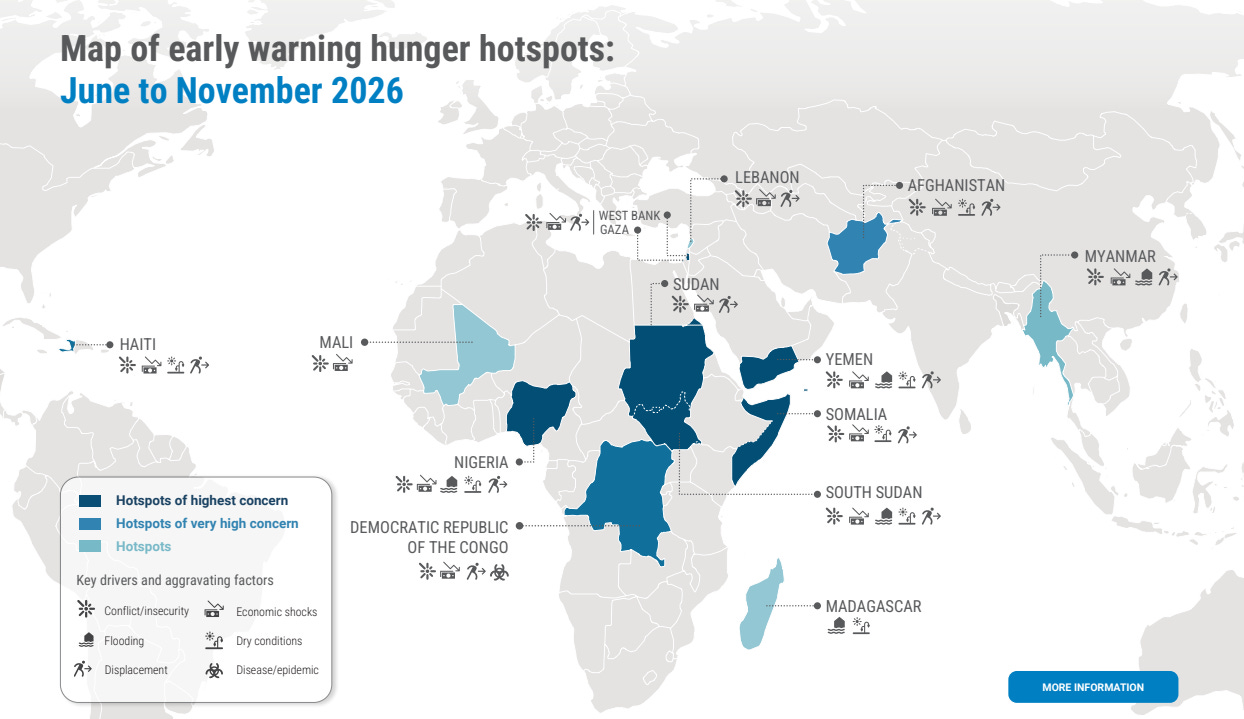
International agencies use a tool called the Integrated Food Security Phase Classification, or IPC scale, to measure the severity of hunger, food accessibility and famine in a particular region. As of today, July 2026, these regions include North Darfur, the Gaza Strip, parts of South Sudan, Yemen and Afghanistan, Haiti, Mali, Burma/Myanmar, the DRC and Madagascar, amongst others. None of these are a huge surprise, but even in this age of history-defying caloric abundance and cheapness, there are an estimated 20.18 million people in Level 4 food insecurity - Emergency classification, and 290,000 in Level 5 - Catastrophic classification. Conflict and war are present in all major famine regions today, with the exception of Madagascar, with floods, droughts, disease and economic shocks on fertiliser prices and other essentials also common denominators.
Noone can be sure how many adults worldwide are taking GLP-1 weight loss drugs. Maybe 20 million Americans, 2 million British adults and half a million Australians are using the medications, primarily for managing obesity and diabetes. More than likely we now have an unprecedented global situation where an equal number of millions are struggling to stop eating, whilst the other millions are struggling to find enough food.
The apparent necessity of peptide drugs to stave off the endless eating mechanism does seem to indicate that, in the presence of abundance and the absence of penalties, a large proportion of the population will grow very large. Domestic animals will do the same. The cessation of cravings is not the same thing as the alleviation of starvation, but the former would seem an evolutionary strategy to prevent the latter.
To end this meditation on hunger I will leave you with some passages from the 2020 book The Science of Starving in Victorian Literature, Medicine, and Political Economy by Andrew Mangham, wherein Victorian clergy, scientists, reformers and writers redefine starvation as an unnatural and abnormal process, in contrast to its historical status as normal, providential and often deserved:
In 1822, the Leeds surgeon Charles Thackrah delivered a series of lectures on physiology to the Philosophical and Literary Society of his home town. Feeling that the information contained in his lectures on digestion was urgently required by the world, he published them in 1824. In that volume, Thackrah outlined the process of starvation in great detail. It involves, he said, ‘constipation of the bowels and [the opposite experience] tenesmus, swelling of the legs, extreme weakness of the muscles, a hollow and ghastly appearance of the face, dizziness, excessive inclination for sleep, debility of sense and intellect’.
He cited an 1818 case which had been outlined by the German physician Christoph Wilhelm Friedrich Hufeland, where a thirty-two-year-old merchant, depressed by ‘severe reverses of fortune’,went into the woods near his home and committed suicide by fasting. In the man’s pocket was found a journal in which he had kept a record of the symptoms he experienced over the fourteen days he went without food and water.
On the third day he wrote: ‘I yet live; but how have I been soaked in the night, and how cold it has been! O God! when will my sufferings terminate!!’ Three days later: ‘How hard is this, no one knows; and my last hour must soon arrive. Doubtless, during the heavy rain, a little water has got into my throat [...yet] I have none even of this for six days, since I am no longer able to move from the place.’
Hufeland’s case study became famous among physiologists, not because of the spiritual raptures of the young man or the pathos of his sufferings, but for what it told them about the material process of starvation… the case was ideally suited to Thackrah’s seeming intention to speak about starvation in a way that stressed its materiality:
In extreme abstinence, we learn that the whole alimentary canal is contracted, and the walls close on the empty abdomen; that the gastric and pancreatic juices, the mucus of the intestines, and even the serum of the peritoneum are partially absorbed. Nay, from the ulcerated state of the villous coat, it seems, that the Conservative Power of the constitution, distressed by the want of nourishment, urges the absorbents to prey upon the live intestine. The blood is said to be depraved.
This last word, ‘depraved’, is very suggestive. Thackrah means it to denote a form of breaking down, or corruption, in the integrity of the blood, yet, combined with his general tone, ‘depraved’, when applied to material phenomena, suggests that hunger is an offensive and unnatural process: when we starve, our viscera cannibalize themselves—the gut becomes a place of warfare as the intestine is predated by the ‘Conservative Power’ of the constitution…
… In Skibbereen, during the height of the Irish Hunger, the physician Daniel Donovan identified what he called ‘famine cachexia [wasting], or lingering starvation’. According to Charlotte Boyce: ‘Famine cachexia caused the starving body to become autophagous—to cannibalise itself.’ What Combe, Lewes, and Donovan, following Hunter, all illustrated was how the ‘characteristic of being able to repair [one’s] own waste’ was a ‘distinguishing characteristic’ of the ‘living body’; it was a natural and a normal process to replenish the empty furnace. The impossibility of obtaining food, as in cases of shipwreck, is decidedly abnormal because it causes one to waste, to flicker, and become extinct.
In recent times, Juan Manuel Garrido has said that ‘hunger means the fact of being alive’, and ‘to live precisely means to be constantly and structurally dying of hunger’. Lesa Scholl has added that ‘some form of hunger seems an inevitable part of the human condition, from the gentle prod of a healthy appetite to dire starvation’. It may seem that such ideas are consummate with the waste theories explored in the previous section, yet medical specialists of the eighteenth and nineteenth centuries would have agreed neither that ‘dire starvation’ and ‘dying from hunger’ are part of the ‘fact of being alive’, nor that they are ‘inevitable’. The gentle prod of a healthy appetite they would have seen as the cue to rectify a diminished amount of energy; what was normal was the maintenance of a nourished body, not the experience of a hungry one. The details of accounts such as Hufeland’s merchant or Ann Martin were extreme examples, yet they underscored how hunger was a pathological state; they also underscore, for us, how vital the materialist view became to challenging entrenched opinions about hunger as something that might be left to its own devices because it was natural. If people starved to death, according to medical men, they did so not in accordance with natural laws, but in breach of them. If, therefore, social policy was to be driven by perceptions of nature’s teachings, it stood to reason that, like the body, the state should be seeking to avoid starvation rather than form an unholy alliance with its fictive inevitability.
Jeff Kaufman has some useful links:
Storing Food
https://www.jefftk.com/p/storing-food
Your Supplies Probably Won't Be Stolen in a [Short] Disaster
https://www.jefftk.com/p/your-supplies-probably-wont-be-stolen-in-a-disaster
Gelatinizing Starch in an Emergency
https://www.jefftk.com/p/gelatinizing-starch-in-an-emergency
This last one sent me down the rabbit hole of solar ovens, and eventually to the conclusion that a windshield sun shade would make a good enough solar oven in a pinch.
Knowing that we’re entering into an era of climate change with this history is terrifying