

Terror and horror are so far opposite, that the first expands the soul, and awakens the faculties to a high degree of life; the other contracts, freezes, and nearly annihilates them. I apprehend, that neither Shakespeare nor Milton by their fictions, nor Mr. Burke by his reasoning, anywhere looked to positive horror as a source of the sublime, though they all agree that terror is a very high one; and where lies the great difference between horror and terror, but in the uncertainty and obscurity, that accompany the first, respecting the dreaded evil?
- On the Supernatural in Poetry (1826) Anne Radcliffe
That Umman-menanu, king of Elam, together with the king of Babylon and the princes of Chaldea, who had gone over to their side, the terror of my battle overturned their bodies like a bull. They abandoned their tents; and to save their lives, they trampled the bodies of their soldiers; their hearts beat like that of a pursued young pigeon, they passed scalding urine, they voided their excrement in their chariots. In pursuit of them, I dispatched my chariots and horses after them.
-Sennacherib Prism, Column 6, adapted from Luckenbill (1924:45-47, 128-31)
In the top quote, Anne Radcliffe laid out a lasting distinction within Anglosphere aesthetics, the separation of terror and horror into categories, each with their own defining characteristics. Between 1789 and 1800, Radcliffe was one of the most - if not the single most - influential and widely-read authors in Britain. She pioneered the Gothic literary form in both novel and poetic form, a genre known as the ‘Radcliffe School’ of fiction whilst she was alive.
Both terms, ‘horror’ and ‘terror’, can be traced back to Proto-Indo-European roots describing the body under threat. Terror comes from *tres-, meaning ‘to tremble’, today we have the Sanskrit trasati (trembling) and the Greek tréō (to flee in fear). In Latin *tres- became terrēre, ‘to fill with fear’, and the current noun terror. Horror derives from a different root - *ǵʰers-, ‘to bristle’, which is a wonderfully evocative word, producing descriptions of the body in all sorts of states. For the Germanic family it came down as words for bristly plants, such as the English gorse and German Gerste (barley). In Latin this bristling turned to fear, so we get horrēre (to bristle, shudder) and ‘horror’ itself, meaning both dread and a sense of religious awe.
Bristling, trembling, dread, shuddering, fleeing. Neither horror nor terror arrived in English through its ancestral Germanic line. Instead both arrived from abroad using two routes: the Old French horreur and terreur via Anglo-Norman, then lifted wholesale from Latin through later scholarship. Horror can be seen in early 14th century literature/writing sometimes with overtones of disgust, whilst terror appears in the 15th century associated with intimidation, such as punishment. Their original bodily meanings of shivering and bristling hair then returned in the 16th and 17th centuries, as Renaissance scholars translated them from Latin.
Ther shal horrour and grisly drede dwelle with outen ende.. Horrour is alwey drede of harm that is to come, and this drede shal euere dwelle in the hertes of hem that ben dampned
-The Parson’s Tale, The Canterbury Tales, Chaucer
For gyf that terrour dred suld be, The terrour is to dred … That ay sall lest … Bot warldly terrour … sone may … away be done
-Legends of the Saints (1400), written in the Scots language
I’m sure many readers would be interested to know - what happened to the native fear vocabulary of Old English? Surely before the Normans arrived there were other words for being frightened?
There was a fairly rich inventory, but most of it didn’t survive past the Middle Ages. Ege and egesa (terror), brōga (terror, dread) and gryre (horror) all died out. Ege was supplanted by its Old Norse cousin agi, which then became awe. The Vikings also brought ugly (from uggligr, ‘dreadful’, ‘a frightful appearance’), scare (from skirra, ‘to shy away’) and anger (from angr, ‘grief, distress’). Some words did survive, but like so many words in Old English, they underwent changes as the language evolved:
fǣr, ‘sudden danger, ambush’, moved from the threat to the feeling and became fear.
fyrhtu became fright, ondrǣdan became dread.
gāst, ‘spirit’, gave ghost, and the related verb gǣstan, ‘to terrify’, gave aghast and ghastly.
grislic became grisly.
lāþ, ‘hateful’, became loath and loathsome, a native word for disgust.
earg, ‘cowardly’, and fǣge, ‘doomed to die’, survived largely in Scots. They are preserved in standard English as eerie and fey, shifting from describing the frightened person to describing whatever is uncanny.
Today, horror is the standard description for those films and media which emerged from the Gothic, sometimes ‘ghost stories’, ‘supernatural’ or newer epithets like ‘gorno’, ‘folk’ and ‘psychological’. We don’t have ‘terror films’ for the simple reason that terror is a word associated with political violence. Whilst this may feel like a post-9/11 phenomenon, the idea of ‘terrorism’ and terror in the political sense dates back to the French Revolution and the pulses of revolutionary terror which rocked the colonial powers across the late 18th century.
Edmund Burke had already defined terror as the foundational principle of the ‘sublime’ back in 1757, working partly with the revival of the sublime as a topic of interest - a French translation of the anonymous Roman-era text De sublimitate had been circulating since the late 17th century. Some four decades later, Burke introduced the term ‘terrorist’ into the English language in his 1796 work Letters on a Regicide Peace. ‘Terrorism’ and ‘terrorist’ were translations of the French words terrorisme and terroriste, terms solidified during and after the Reign of Terror.
Quite why the French revolutionaries adopted the language of ‘terror’ is curious, it’s a phrase that we’ve taken for granted, something that seems obvious given what it describes. Today terrorism is occult, in the sense of being hidden, it describes the use of random, unpredictable violence towards a political end. The Reign of Terror was not this, it was terror as public virtue, as spectacle, it was radiant and magnificent and conducted for all to see. The rest of this essay is going to explore this form of instrumentalised terror, then compare Revolutionary France to one of the most fear-inducing ancient states to ever exist - the Neo Assyrians, the masters of extraordinary public dread.
Terror in France
The fear and violence which washed over France during the Revolution became the emulated prototype of left-wing revolutionary violence for the next few centuries - a leadership vanguard, mass popular assemblies, a mix of spectacular and mob deaths, denouncements, lists of ideological enemies and the use of the state to organise and direct arrests, imprisonments and executions.
The Revolution saw gruesome violence aimed at the old regime’s aristocrats, then a cleansing violence aimed at the new regime’s opponents (priests, nuns, minor landed reactionaries), a mass violence aimed at external threats, then the use of terror to cow upstart citizens and keep them in their place. The 1793 Revolt of Lyon ended with revolutionary troops tying groups of rebels together and firing grape-shot from cannons into them at point-blank range, the spattered remains of any survivors were then bayoneted on the streets. In Nantes, Jean-Baptiste Carrier had ‘counter-revolutionaries’ taken from their beds and loaded onto flimsy barges under the cover of dark. These boats were pushed out into the Loire River and scuttled, drowning the hundreds of priests, prisoners-of-war and unfortunate men, women and children of the city who had been named as regime opponents. The more extended War in the Vendée (1793-96) remains a live political issue in France, with historians debating over the number of dead (possibly 25% of the entire region) and the motivations of the insurgent rebels (pro old regime or anti new regime) - regardless, the use of indiscriminate violence, property destruction and wholesale targeting of a population for liquidation marked a new watershed in ideological state oppression.
The paradigm shift from the old world of kings and dukes to the Committee of Public Safety is disorienting, but the ideas behind the Terror were a long time in the making. To my mind there are some crucial thinkers and concepts which helped leaven this mess: Montesquieu; Rousseau; Machiavelli; ancien royal justice; imitations of antiquity and the more general concepts of renewal, purity and restoration.
In Montesquieu’s The Spirit of the Laws (1748), he outlines the single underlying principle for the different types of governance models: monarchy - honour, republic - virtue, despotism - fear. Robespierre’s insight was to rework the formula - by placing republicanism and despotism in opposition to one another, a republic which uses fear and terror against tyranny is virtuous, so long as the terror is targeted only at the enemies of the republic. In Robespierre’s own words from his speech ‘On Political Morality’ delivered to the Convention on Feb 5th 1794:
It has been said that terror was the mainspring of despotic government. Does your government, then, resemble a despotism? Yes, as the sword which glitters in the hands of liberty's heroes resembles the one with which tyranny's lackeys are armed. Let the despot govern his brutalized subjects by terror; he is right to do this, as a despot. Subdue liberty's enemies by terror, and you will be right, as founders of the Republic. The government of the revolution is the despotism of liberty against tyranny. Is force made only to protect crime? And is it not to strike the heads of the proud that lightning is destined?
From Rousseau the Revolution took the concept of ‘La Volonté Générale’ or ‘the General Will’ which appeared in his 1762 book The Social Contract. The General Will was taken to mean roughly the consensus of the majority, and the new regime pronounced itself the executor of that will, and opponents of the regime as defying the democratic majority. This belief, combined with a Machiavellian view of statecraft under necessity, produced a governing ideology which appropriated all ethical concerns, all morality, into one supreme ruling body imbued with the right to annihilate all dissenters.
The revolutionaries were also avid readers of Plutarch, Livy, Tacitus and Cicero. Sparta was a crucial model and Rome supplied justification for emergency precedents. The Committee of Public Safety echoes Cicero’s salus populi suprema lex - just as the consul had crushed the Catilinarian conspiracy, so the Committee would suspend normal laws to protect the state.
Terror was innate in revolutionary government because virtue was; in Robespierre’s imagination they became inconceivable apart. And if these were innate, so too was Sparta. For terror is virtue applied with what Saint-Just hailed as Lycurgus’ “merciless inflexibility.” Terror is the principle of a society imperiled by an existential threat which has neither beginning nor end, and will persist as long as it does
-Lightning in Vast Shadows: Sparta & the Reign of Terror (2012) Varad Mehta
Royal justice from an earlier age would create spectacular punishments as an example, bringing terror to the wicked and inscribing monarchical authority directly into the victim’s flesh. The Roman concept of in terrorem aliorum, for the terror of others, was rendered as a terrour d’autres by the Anglo-Norman and French kings. Punishment created fear and dread, the more horrific and public the better. Revolutionary terror inherited this apparatus and wielded it very effectively. Finally, God’s justice was traditionally conceived of as terrible, wrathful. Robespierre’s emanation of virtue made terror into a kind of dazzling, shining power that radiated from the moral purity of the Revolution, striking from above on the heads of traitors, counter-revolutionaries and the suspicious.
Combined together, this mixture of influences produced a severe new form of mass politics. Ideologically committed to violence, self-righteous in its claims to virtue and a single version of correct action, fanatical in its application of social remedy. There is no doubt that the French Revolution created the archetype of revolutionary terror, constructed on necessity - the fear of foreign invasion was well-founded, but that only made the revolutionaries more determined to stamp out resistance. Let’s turn now to our other historical epoch of state terror - Assyria.
Terrible Wrath, Vengeance Upon Oath-Breakers
I built a pillar over against the city gate and I flayed all the chiefs who had revolted and I covered the pillar with their skins. Some I impaled upon the pillar on stakes and others I bound to stakes round the pillar. I cut the limbs off the officers who had rebelled. Many captives I burned with fire and many I took as living captives. From some I cut off their noses, their ears, and their fingers, of many I put out their eyes. I made one pillar of the living and another of heads and I bound their heads to tree trunks round about the city. Their young men and maidens I consumed with fire. The rest of their warriors I consumed with thirst in the desert of the Euphrates.
-Ashurnasirpal II on his treatment of the defeated rebels at Tela
The Neo-Assyrian Empire (911-609 BC) of the Iron Age Levantine world is about as distant as it gets from the French Revolution - beginning with the ascension of Adad-nīrārī II and the reclamation of lost Assyrian territories, and ending with Ashuruballit II after centuries of unprecedented expansion. The Neo-Assyrians fought to take back their old provinces, and in doing so discovered a formula for success that allowed them to conquer people after people, including Babylonia and even mighty Egypt herself in 673 BC. Many of these wars and invasions are captured hazily in the Old Testament, such as Sennacherib’s failure to capture Jerusalem, as well as by writers such as Herodotus and in the Assyrian’s own writing and inscriptions. The sudden, dramatic collapse of Neo-Assyrian civilisation has been attributed to all sorts of possible events - civil war, drought, rebellions in Babylonia and an external invasion by the Medes - but this has never been fully resolved.
The Neo-Assyrian impact on world history and the reputation they left behind is fascinating to think through. They are mentioned over 140 times in the Hebrew Bible, and scholars have put forward arguments to the effect that Israelite self-conception, their nationalism, theological traditions and even Jewish monotheism itself were all reactions to Assyrian imperial aggression. Neo-Assyrian royal ideology underpins the idea of ‘universal empire’ and ‘universal rule’, and their dynasty sits within the framework of empire succession - admired by the Greeks, Romans and later Europeans. One of their greatest parting gifts to posterity is the memory of their ruthlessness, severity and knack for psychological warfare, all neatly captured in the unique set of graphically violent friezes, reliefs and artworks they manufactured and displayed.
The Neo-Assyrians, especially, provide very detailed visual and textual depictions on the stone slabs they designed to protect the walls of their buildings, constructed underneath out of clay. The palaces of the Neo-Assyrian kings were decorated with stone panels over very long distances, allowing the artists to represent huge cycles of stories… The large quantity and apparently excessive details of the depictions of cruelty from Neo-Assyrian civilisation may therefore be a consequence of local customs. Certainly, war in this period permitted excesses of violence to happen, but these scenes are more the tactical issues of an ideological aspect than the historical narration of particular events, although cruelty was still a good means of compelling the reluctant inhabitants of enemy cities to think about submitting…
… the basic components of this iconographic repertory develop during the reign of Assurnasirpal II as follows: cutting the throats of enemies, decapitation of enemies with the scraping-knife, the bodies of enemies, decapitated or not. Salmanezer III continued the tendencies innovated by his predecessor, although he developed many more. These include, specifically, the washing of the enemy heads, the piles of heads, or the “tents” of heads covering living prisoners, the heads laid out on the ramparts captured after siege, as well as the dismembering of the bodies of enemies, the amputations, and the preparation of impalement of the “major” type. In the end, more and more varieties of torture followed, like the “complete” impalements of whole or dismembered bodies, the mass pyres, the groups of impaled enemies, or, more simply, their scattered, cut-up, and decapitated bodies…
Sargon II diversified too, and again, the range of representation of the practical details of dismemberment, and the depiction of the destruction of statues of the divinities worshipped by his enemies. This type of torture would also have been much appreciated by the successors of Sargon II. He is, so far, the only Neo-Assyrian king under whom the representations of tortures correspond almost completely to the references in the texts. Among these mistreatments are included the massacre of a great number of civilians and warriors, flaying people, as well as putting people in irons. Only the impalements, and prisoners with pierced lips, fixed by a ring attached to a leash held by the king, who is busy thrusting a spear in an enemy’s eye, were represented without corresponding examples being found in a preliminary analysis of the texts.
-Fragmentation of the Enemy in the Ancient Near East during the Neo-Assyrian Period (2010) Fabrice de Backer
You have to hand it to the ancient Assyrians – they were honest. Their artistic propaganda relishes every detail of torture, massacre, battlefield executions and human displacement that made Assyria the dominant power of the Middle East from about 900 to 612BC. Assyrian art contains some of the most appalling images ever created. In one scene, tongues are being ripped from the mouths of prisoners. That will mute their screams when, in the next stage of their torture, they are flayed alive. In another relief a surrendering general is about to be beheaded and in a third prisoners have to grind their fathers’ bones before being executed in the streets of Nineveh.
- Jonathan Jones, visiting the ‘I Am Ashurbanipal’ exhibit at the British Museum in 2018, writing for The Guardian
It would take an entire book to go through the evolution of how the Neo-Assyrians depicted the grisly business of imperial conquest and submission, suffice to say the violence was of a public, spectacular and impersonal character. Almost all scholars agree on the basic impulse behind these actions, since they are written into the narratives of the artwork - the cycle of rebellion, military clashes, sieges, victory and punishment. Cities which attempted to throw off the Assyrian yoke, close their gates to the king, commit aggression against his majesty’s realms and subjects - retribution would follow, and it would be merciless. Faced with this harshness, the risk of one’s children being burnt alive or being skinned and draped over the city walls, there’s no surprise most vassals chose to submit and do as they were told.
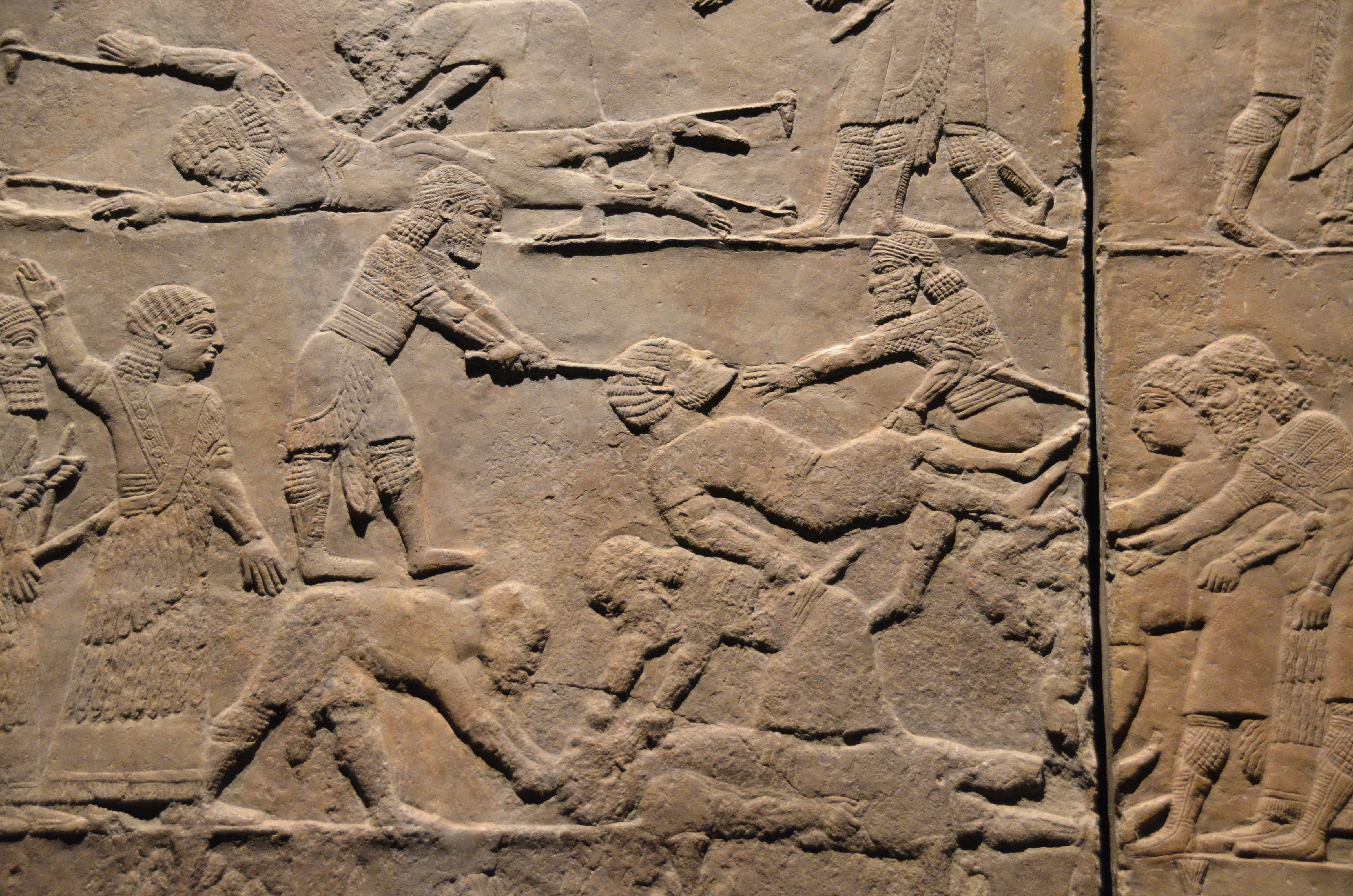
The inscriptions which accompany the visuals are typically in the first-person style of the king as author, executioner and divine restorer of rule - “I, the king, did this to them and this to them, they, the disloyal oath breakers, have disturbed by kingship and I dismembered them like a lamb on a block, I hung them from their city gates”. Oaths of loyalty to the king were also divine promises to the god Ashur, and breaking those was the first step to chaos. Lying was to speak with an evil tongue, lighting the road towards sedition, rebellion, disorder on a cosmic scale. The king was the human who could stand between this abyss and the peoples of the world, hence his mission to extend his dominion to all corners of the earth. Neo-Assyrian authority had a baked-in compulsion to seek out rivals, borderland nations and what lay beyond those, to use diplomacy and violence to subjugate and swallow up their neighbours. Rowdy newcomers or rebellious underlings could be trashed and scattered if needs be, the mass deportation and resettlement of peoples was a common tactic - in a similar way to the Incan empire.
As an aside, the long-running focus on city gates for Near Eastern civilisations is interesting. Neo-Assyrian kings specifically hung or displayed city rulers from their own city gates to make a point. Sacrifices and offerings to different gods directly within city gates were common throughout various points of Sumerian, Akkadian, Babylonian and Hebrew urban history. Gates into temple courtyards functioned similarly - in 2 Kings 23:11 we see Josiah excavating and burning the chariots and horse bones which had been interred under the temple entrance as an offering to the sun god:
And he took away the horses that the kings of Judah had given to the sun, at the entering in of the house of the Lord, by the chamber of Nathanmelech the chamberlain, which was in the suburbs, and burned the chariots of the sun with fire.
More important than the city gates though is the very ancient concept of melammu, which the Neo-Assyrian kings made use of in excess. Few ideas have had the continuity that melammu has, at least 4,500 years, beginning in Mesopotamia and surviving into the present. It translates as ‘divine aura, radiance, splendour’, with overtones of mortal terror and submission to the gods. Byzantine and Catholic iconography borrowed this idea in the form of a blazing halo around the heads of angels and saints, the Achaemenids used it to depict gods appearing to men - see below a Black Sea seal of Anahita presenting herself to a king.
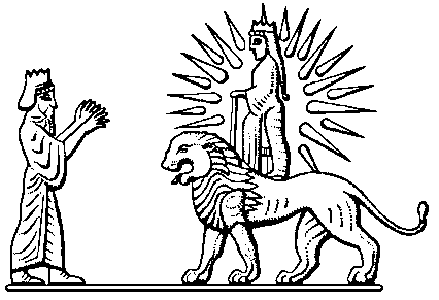
Of course, the Neo-Assyrian monarchs went further than most and granted to themselves this shining light of resplendent dread. The phrase pulḫi melammi bēlūtı̄ya is key to understanding this:
According to Aster, there are four meanings of melammu in the NA [Neo Assyrian] period; all of them are strictly connected with waging war, military campaigns and the power of the gods and kings who led them. The first term, melam bēlūtija, is connected with lordship. In special cases the NA kings unleashed melam bēlūtija upon their enemies, a particularly violent show of force. It refers to royal power exercised against treacherous, enemy kings. Many NA kings use the phrase:
“I unleashed upon them the melammu of my lordship (melam bēlūtija)”.
The second is pulhe melamme, meaning “terror of (one’s) melammu”. It refers to the terror caused by the reputation of the god or king. Aster noticed that there is a distinction between divine and royal melammu. When the enemy against whom the Assyrian king is campaigning runs away and abandons the city, their flight is said to be a reaction to melam bēlūtija (my lordly melammu), i.e., the melammu of the king (the third type of usage).
-Melammu – The Symbolic Representation of Gods (2017) K. Ulanowski
So we have the luminous, inner light of the Assyrian king, a light bestowed upon him through his bridging the world of man with the gods, and his responsibilities to keep chaos at bay and unite the world under his rule. When those in his realm breach this peace and violate their sacred oaths, he is duty bound to bring radiant terror down upon their heads - to be the bearer of that immortal presence and aura into the lives of ordinary men. What better way to show his subjects that he can channel this luminescence than to pile up the decapitated heads of soldiers, drape the skins of rebellious nobles over their own walls and reduce the city king to a quivering, crying pig, bound in fetters and suspended from his own gate - then impaling him alive in front of his own subjects?
That kind of terror obviously cannot be reduced to the safe distance of Burke’s sublime. For the men and women on the receiving end of an Ashurbanipal or Sargon, the terror would have been very real and utterly paralysing. That particular quality the Neo Assyrians possessed, where the violence was swift, impersonal, brutal and spectacularly public, we today cannot help but feel it as alien. Our world is violent of course, but we have nothing equivalent to a universal monarch on the border who may rain down fury and terror at his pleasure.
Terror as instrumental, terror as affect
One reason I began researching this topic was because I was thinking about fear and terror as emotions, and whether any society or culture ever curated or intentionally produced experiences which the participants found terrifying. It turns out that there are - societies which have secret clubs of masked men who pretend to be frightful spirits and attack their own villages, others which built artificial cave-like structures into which people would go while intoxicated and beside themselves with anxiety and dread. Then I started thinking about how to differentiate those which used terror in order to achieve something - instrumental, and whether any managed to produce the affect for the sensation itself alone.
Clearly both the Revolutionary Terror and the Assyrian use of terror in warfare and art are both cases of the instrumental. This type of fear served a clear purpose, or purposes. One had ideological roots, the other religious, both had pragmatic reasons to instil terror. The strategy is to overcome the precarity of the ruler’s authority with overwhelming force against rebels, in order to ‘encourage the others’ and pacify far-flung populations. Excess, cruelty and wildly disproportionate violence is the cost of maintaining order under such conditions. Other modern revolutionary movements and other Near Eastern civilisations experienced similar dynamics.
However, there is a kernel of something more than utility in the idea of ‘terror as virtue’ and pulḫi melammi bēlūtı̄ya, and that is in the terror of the defenceless against that which seems close to divine in power. The fear of God, other beings, the terror of devils, demons, ancestral or vengeful spirits, beholding something else from somewhere else - again we lack this phenomenological experience. Modern democratic rulers, despots and soldiers would struggle to project anything like the aura of an Assyrian king. The short-lived existence of Islamic State/ISIS is probably the only comparable event in recent times, and even at its acme was more of a rogue group of thugs than a manifestation of ‘radiant terror’.
I want to explore other examples in the archaeological and anthropological records of societies and places where this strange form of affect was cultivated and refined - various Mesoamerican peoples, Rome, parts of the Chinese timeline, New Guinean and Amazonian groups. I hope readers will find this part of the human experience as curious and as worthy of attention as I do.
Bloody hell. Thank goodness I live in grey, boring, surburban Leicester.
Appreciated the timing of this fascinating and disturbing piece. I've been thinking about what it says about the culture, here in France, that they still celebrate acts of terror.