

As we’ve already explored, the invention of the horror genre in the West came from inbuilt cultural and psychological tensions. Without these tensions, a story that aims to frighten or scare feels merely folkloric, akin to a fable or parable. Cinematic drama, comedy or romance can be compelling, no matter where in the world it comes from - horror on the other hand, has to share certain psychological resonances. Bollywood/Hindi-language films do contain attempts at horror, but they are rarely serious enough to garner attention from Western audiences.
Japan is the, almost singular, masterful exception. Throughout this series I’ve had to stop myself from referencing Japanese equivalents in virtually every area of study - serenity, the grotesque, psychological and internal conflict, demons and possession, skin and body horror, masks, repression, order vs chaos and all the rest, from motifs to deep cultural themes. When I was researching and thinking through my ideas about northern vs southern European differences, and the role of masks and the face throughout European history - I kept having to bracket off Japan, so much so I began to wonder if my whole project was flawed. Now I don’t think so, and I believe there is an explanation for this resonance which supports my overall argument.
Before we dive in I should clarify a few points: what Westerners refer to as ‘J-horror’ typically refers to the time period of films which successfully crossed the divide into Hollywood, roughly the mid-90’s to early 2000’s. In this piece I’ll be using J-horror to point at both those well-known films but also wider and deeper Japanese horror/ghost story-making and media. I also want to anticipate the obvious challenge that Korean horror, or K-horror, is a very popular and growing genre in the West. Without spending a whole essay on the subject, I believe that K-horror is best understood as a secondary formation rather than an origin-point. The genre is (in my opinion) a deliberate adaptation of the already globalised horror grammars from the West and Japan, to distinctly Korean structures of family melodrama, social pressure and critique/metacommentary. I will not elaborate more here, hopefully this argument will make sense by the end of the article.
Sharing Western interfaces
Japanese cinema and horror media are not footnotes or mere derivatives of the Western canon. Japan’s highly original and distinctive cultural ‘givens’, or metaphysical starting points, clearly make it feel to a first-time viewer that they are encountering a different civilisational space. J-horror uses the same modern stages the West lives in (domestic space, school, technology, commuting life) so the viewer doesn’t need any cultural translation for the setting. However, it powers those settings with a distinct logic: obligation, pollution/contamination, place-memory and curses that behave more like algorithms or transmissible diseases than moral punishments.
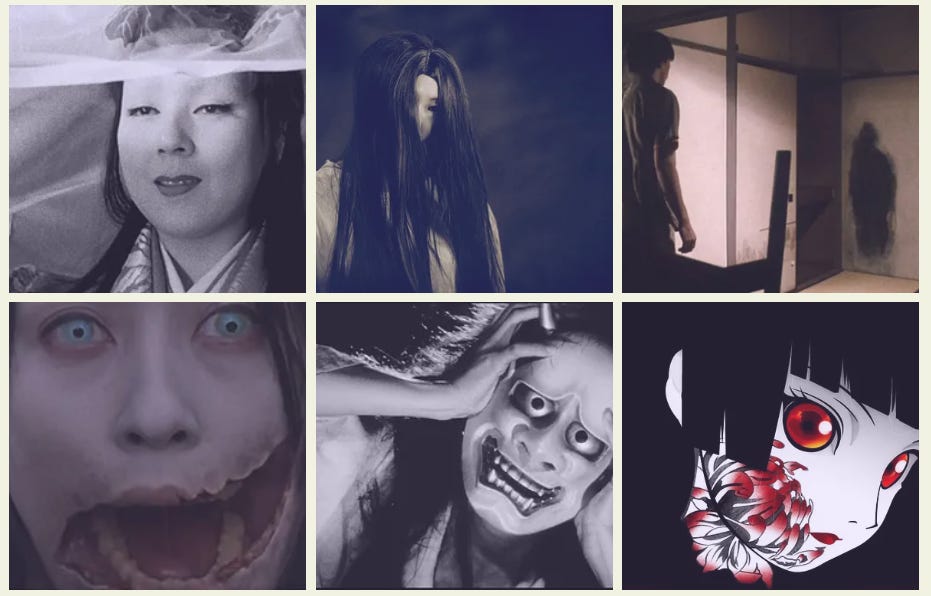
To help orient us first within the larger framework of J-horror, let’s go through some of the main motifs which make it stand out:
Long black hair as a horror instrument
Hair with agency. Roots in mourning, kabuki, style of ‘masking’. Hiding the face, unnatural and tendril-like movement, a veiling boundary between the living and the dead. Eg Tomie (1999), Onibaba (1964)
Faces withheld rather than revealed
Western horror revels in the reveal (unmasking, the jump-scare). J-horror often terrifies by refusing this facial legibility, with the head lowered, hair curtain, turned away, static blankness, an uncanny face that doesn’t emote properly. Eg Kwaidan (1964), Siren / Forbidden Siren (PS2, 2003)
The onryō logic, vengeance is a force of nature
The vengeful spirit is a cosmic remainder, an unpaid debt, rather than an agent of evil. Western horror has revenge ghosts, but J-horror makes this part of its cultural-cinematic engine. Eg Ugetsu (1953), Tōkaidō Yotsuya Kaidan (1959)
Grudge horror
You walk into the wrong relational stain (house, object, family line, location), which can then spread outwards. Eg Ju-on: The Grudge (2002), Toire no Hanako-san, (1995)
Horror via transmission media (tape/phone/photo/site/rumour)
J-horror treats curses like information, to be copied, propagated, to recruit you into passing it on. The West has chain-letter tropes, but J-horror made replication one of the genre’s defining mechanisms. Eg Ringu (1998), One Missed Call / Chakushin ari (2003)
Domestic claustrophobia and dread
Bathrooms, corridors, genkan/thresholds, stairwells, futons, cramped apartments, all create a suffocating intimacy. Not a haunted house exactly, more like being stuck in a micro-universe or a maze. Eg Dark Water (2002), House / Hausu (1977)
Crawling/contorted locomotion as a signature movement
One of J-horror’s best known motifs - the body moves wrong. Low crawling, joint reversal, twitchy resets, broken rag-doll kinetics. Western horror does use contortion too, but J-horror made this a globally understood grammar of the non-human getting inside the human. Eg Pulse / Kairo (2001), Yomawari: Night Alone (2015)
Ritual pollution and cleansing. Eastern metaphysics
Often an implied or presupposed world where uncleanness, taboo contact, and failed rites have consequences. The Western mode is to frame spiritual threat through sin (internal violation). Japan, like other East Asian/Buddhist/animistic cultures, frames it through boundary violation. Eg Noroi: The Curse (2005), Kuon (2004)
The dead are socially present, they have unfinished business
Ghosts are persistent cohabitants of space and time. Western ghosts might want a message to be delivered. J-horror ghosts might linger as an ongoing condition. Eg Gakkō no Kaidan (1995), Corpse Party (1996 / 2012)
Urban legend monsters
Many Japanese folk-devils/monsters function like mini street-level closed scenarios. If you answer wrong / go there / say that, the sequence is triggered. Kuchisake-onna (2007), Hanako-kun (game/anime variants)
Animated-object spirituality
Objects are potentially alive, offended, even mundane items might have agency.
Western horror has dolls and cursed artefacts, but J-horror can imply a world where object agency is more than a gimmick. Eg Hell Girl / Jigoku Shōjo, Fatal Frame / Project Zero (2001)
Sound as possession marker (croaks, clicks, breath, wet throat noise)
J-horror leans hard on bodily noises (and silence) as a marker of wrongness. Eg Audition (1999), Silent Hill 4: The Room (2004)
Deeper than these motifs or elements are the wider thematic styles which Japanese horror has become celebrated for, these include the paced build of dread and suspense, an acute wielding of psychological terror and the successful melding of folkloric and older storylines with new technologies and mediums. It is also impossible to imagine modern video game horror without Japan’s influence: Silent Hill, Resident Evil, Siren. Since the 1990’s, J-horror has become an indispensable part of the wider horror media landscape, in particular with Japan’s overall domination within online aesthetics, memetic internet culture and animated storylines.
Compressed modernity: Japan’s breakneck acceleration
Readers of this series might remember my argument, that the advent of modernity drove the deep psychological internalisation of the self ‘at war with itself’, or at least a self which cannot know its own mind fully. Japan underwent probably the fastest modernisation period in history, the Meiji Era of 1868-1913. The end of the Tokugawa shogunate in the wake of a feudal order encountering the power of external, modern military and economic force, caused a systemic and then centralising shock. The Meiji Restoration saw a new constitution imposed across Japan, a nation state built over the regional differences and divides which had always plagued the archipelago. This new state was envisioned as democratic, rational, bureaucratic, industrialising, liberal and future-oriented (destroy the old castles, smash the shrines) - there was to be no place for the ghosts, monsters and folk-lore of the superstitious past:
What are called “ghost stories” [kaidan-banashi] have greatly declined in recent times; there is hardly anyone who does them at the variety halls [yose]. That is to say, since there are no such things as ghosts and they all have come to be called neurosis [shinkeibyō], ghost stories are unseemly things to the professors of civilization [kaika senseikata]. . . . By saying that it’s a neurosis because there’s no such thing as fox-possession and goblin [tengu]-abduction, they completely fob off any and all frightening things on neurosis.
-San’yūtei Enchō, Shinkei Kasane ga fuchi (1888) in Enchō zenshū
We’ll refer to this as ‘compressed modernity’, the total transformation of Japanese lifeways, a phenomenon which took centuries in Europe and only decades under Emperor Meiji. Such compression leaves uncanny traces and shadows in its wake. As the old shogunate crumbled away, spontaneous Ee ja nai ka dancing festivals broke out, as did bakumatsu bakemono ‘grotesque’ or ‘monstrous’ apparitions and scenes of supernatural change. In Osaka, there were ‘monster riots’ (yōkai sōdō), and across Mito and Shimosa there were tengu sōdō disturbances, including looting and rioting. Fears of the Western barbaric outsider became especially acute in the early Meiji period: not only had the Western habit of drinking wine and ‘blood’ during church services been translated into popular beliefs about vampiric outsiders, but it was rumoured that ‘strangers’ (ijin) would appear in the countryside and kill people (ijingoroshi). Worse still, these strangers might actually drain your blood or bone marrow away, a terror which led to the 1873 Okayama ‘blood-tax’ riots (ketsu-zei ikka):
the Okayama blood-tax riot, as well as those in Tottori, Kagawa, and other areas, arose from a much more broadly based sentiment against government collaboration with foreigners in the program of civilization and enlightenment. Ketsutori (blood-taking) was not the only word commoners used to signify the object of fear associated with military conscription; aburatori (fat- or marrow-taking) and kotori (child-taking) were also used. According to one contemporary article critical of the official explanation for the riots, the idea of blood-taking (or fat-taking or child-taking) circulated among the populace well before the 1873 conscription order, usually in association with Western foreigners who, since the end of the Tokugawa period, had been believed to “take the lifeblood of children and refine medicines with it, mix the fresh blood of pregnant women and drink it in medicines, and also coat electrical wires with the blood of virgins.”
-Civilization and Monsters: Spirits of Modernity in Meiji Japan (1999) G.A. Figal
The new Enlightenment-style Meiji state took aim at these and many other remnants of folk-beliefs, such as the misemono street shows, yose variety halls, ghost story recitations and many more. To the ordinary rural Japanese villager, the government had itself become a demonic force, seeking to uproot tradition and suppress their inherited explanations for disease, misfortune and death. That being said, when the 1868 leadership announced the Shinbutsu Hanzenrei, the official separation of Shinto and Buddhism, it unleashed a tsunami of pent-up anger and violence towards the institutions of Buddhism - leading to the most intense period of haibutsu kishaku (‘abolish Buddhism and destroy Shākyamuni’). The greater crime perhaps, in the eyes of the ordinary populace, was the later Jinja seirei Shinto shrine consolidation ordinances, which aimed to abolish and aggregate large numbers of small, rural shrines, to help create a state-run Shinto religion. The vandalism and destruction of many tiny, carefully tended shrines deep in the woodlands caused great outrage and opposition, complete with charges of angry homeless kami spirits. After the 1905 war with Russia, the government capitalised on its power to enshrine the souls of the deceased soldiers, again to the outcry of families and local shrines.
These are just some of the many examples which illustrate the Meiji era tensions between the rapid, centralising forces of modernisation, and the older, distributed forms of power and knowledge. To create a homogeneous and nationalistic state, the Meiji government had to stamp out everything from informal shamanic healing to institutionalised Buddhism. In smoothing out and eradicating the intensely localised wrinkles of folk-devils and superstition, Japanese society underwent the same process of psychological internalisation and vulnerability to the irrational as the Westerners they sought to learn from.
A psychological core without Western confession
It would be easy to simply fall back on the neat binary that the West vs Japan represents a ‘guilt-based’ culture vs a ‘shame-based’ culture - but I think we need to do better than that. The compressed modernity timeline, in particular between 1868-1913, created a complex and contingent set of psychological pressures on Japan.
In attempting to copy or borrow institutions from the West, Japan entered something of a paradox: how to create a liberal individual who precedes and resists the State (a prerequisite for Anglo-American constitutional law) using the mechanisms of the State? The more communal, clannish, ancestrally-bound people of Japan were forced to be free and then handed a list of rights and duties as citizens which made little sense and were hardly desirable to begin with.
A new idea was needed to conceptualize progress as it transpired at the collective level and to act as the counterpart of the individuated person. In the West it was called “society,” and in Japan shakai (coined by Inoue Tetsujirō)… Society “enabled Japanese intellectuals to rethink Japanese society on a new scientific basis and to produce new interpretations of Japan’s past, present, and future… Before 1880, no standard translation for “society” existed; “indeed, one can insist that there was no such concept in Japanese.” Originally, terms designating small face-to-face, self-selected, concrete groups (gangs, clubs, and guilds) that denoted “associating” or “fraternizing” were employed. Kōsai (“interaction”)—as in “human society” (ningen kōsai or hitobito kōsai)—and setai (“the human world”) would also be used.
-The History of Japanese Psychology: Global Perspectives, 1875–1950 (2017) B. J. McVeigh
The foundational material for this new democratic, individualistic society was the feudalism of the Tokugawa period, and its popular ethical system of shingaku. In the 1835 collection of moral tales - Zoku Kyuo Dowa - the authors aim to teach both absolute subservience to authority combined with a spiritual doctrine of ‘no-self’:
If one had no selfish motives but only the supreme virtues, there would be no self. . . . If he serves selflessly, he does not know what service is. If he knows what service is, he has a self. If you think that you work diligently, it is not true service
Moulding a positivistic, utilitarian and science-minded citizen from this substrate proved largely impossible, even for the Meiji ruling elites, so they emphasised the role of the state in building the people first - whilst promoting devotional worship of the Emperor. Submission to authority, combined with no outward manifestation of egoism - a resignation to Heaven’s law, to fate - fatalism even: these were the qualities most Japanese people had inherited according to the psychologist Hiroshi Minami, who authored the classic 1953 work Nihon-jin no shinri (Psychology of the Japanese People). Minami leans towards irrationalism, elasticity and most of all - ambiguity - as the defining features of the modernising Japanese. A people who neither rejected science, logical analysis, rationalism; nor fully embraced them. As imports, these world-views created a ‘leftover’ tension:
I use the so-called abstract nouns of foreign origin only for the purpose of analysis, but when it is a case of measuring a man’s philosophy of life, I am careful to use them as little as possible.
-Ryoshu [Loneliness on a Journey] (1950) Yokomitsu Riichi
Stop leaning toward such an un-Japanese thing as analysis and theory.
-Toyo nodo no kyogaku [The Way of the Farmer-Warrior] (1939) Sugawara Hyoji
The great turn of modernity, the turn inwards, has a confessional tone in the West arising from centuries of Christian theology and structure. The Western Christian self was built from barbaric materials and disciplined through an imagio dei which moralised the interior. Japan’s encounter with modernity also created a new kind of inward facing self, but without the Christian confessionalism - which is impressive when we consider that Japan embraced the field of psychology, a field saturated with implicit Western assumptions about how the self functions and becomes dysfunctional.
In 1877 the University of Tokyo was founded, and Toyama Masakazu began teaching shinrigaku - a concept meaning ‘mental philosophy’ or ‘study of the mind’, which minimised the experimental focus of Western psychology and looked instead Buddhism, areas of religious agreement between East and West and practical applications such as pedagogical psychology. Education was the early Meiji era’s main use of psychological learning, attempting to standardise and modernise the whole edifice. Pupils were taught to spatialise the world mathematically; that the moral cosmos was structured through the interior and not ‘out there’; the mind’s eye created space for a self-reflective subject, an ‘I’ that does the thinking; circumstances were contingent and time linear, a subject can make progress, like society. All are necessary to create the autonomous, rights-bearing agent, and all left a sensation of breakneck dislocation and disorientation.
Literature, rather than psychology, probably better expressed this sensation during and after the Meiji era. Writers like Natsume Sōseki, Tayama Katai, Shimazaki Tōson and Mori Ōgai still remain trailblazers of literary modernism in Japan. Much of their work deals with the subjectivity of the new man under rapid modernisation, their loneliness, alienation and internal detachment from the past. The entire concept of the ‘confessional’ self-conscious novel, an ‘I’ novel, has been debated as to whether it precedes an interior subject in need of confessing, or if it creates that subject through a kind of internalised dialogue with the text.
Like the system of genbun itchi, the system of confession has been naturalized to the extent that we no longer notice it. Examining the process through which genbun itchi was institutionalized reveals it to be a kind of writing which has nothing in common with either the speech (gen) or the writing (bun) of an earlier time, a writing whose origins have been repressed from memory. People came to think of themselves as simply recording “speech” (gen) by means of “writing” (bun). Similarly, confession is not simply a matter of concealing one’s sins, it is a system. It is the existence of the system that gives rise to the need to conceal, but we do not perceive this…
Katai labored to tell the “truth”, but it was the system of confession that made his truth visible. The system of confession preceded the action of confessing, in much the same way that the confessional techniques of psychoanalysis gave substance to the concept of the unconscious. There is no a priori “spirit” but only what has been produced by the system of confession.
-Origins of Modern Japanese Literature (1993) Karatani Kōjin
Ultimately it is fool’s errand to attempt a thorough cultural and psychological explication of modern Japan, there is no ‘nucleus’ or ‘kernel’ of culture or self-hood. However, its clear that the process of modernisation from the 1860’s onwards radically transformed pre-existing Japanese cultural relations, religious beliefs, affinities, sense of personhood, relationship with authority and so much more. Exposure to and training in European Classical-Christian-Enlightenment-Romantic universalism was an ordeal which produced immense individual turmoil and national progress. The self which was born at this time was unique, semi-confessional, raw; estranged from the past and an outsider to the future. Sōseki’s epigram - sokuten kyoshi, “Be in accord with heaven and reject the self” - may be his attempt to ‘return’, or his attempt to move beyond and ‘transcend’, anything but being stuck here.
The overlap - what J-Horror shares with the West
Without making this article too long, it seems necessary to cover those areas where J-Horror taps into Western psychology, in some cases going above and beyond what Western Horror can produce. We’ll limit ourselves here to: domestic enclosure, numinous technology and performative normality.
Domesticity and claustrophobia are powerful lenses in horror, sharpening and heightening the primitive sensation of being trapped. Both J and W horror share a resonance with modern alienation, in architecture and human relations. In both traditions, horror works by turning supposed intimacy into entrapment. The corridors become narrow, the rooms become repetitive, the plumbing leaks, doors no longer protect. The house starts to feel like an extension of the psyche, a point true of Western films like The Shining and Repulsion, where confinement and mental pressure are inseparable from the built space, and true of J-horror films like Dark Water and Ju-on, where apartments and houses become machines for dread rather than shelters. J-horror differs in that the architecture more often feels saturated by residue or a curse. In line with Japan’s religious heritage, to be ‘haunted’ is less a point of revelation (a very Western valence) and is rather concerned with ‘contamination’. Water keeps recurring in films like Ringu and Dark Water - a constant sign of dread, seepage. Water points to a failing boundary. The ceiling leaks, the tank overflows, the building sweats, the dead return through dampness. This ‘residue’ refuses to leave, a perversion of ritualistic cleansing methods like misogi and harai. Western horror wants the catharsis of confrontation and revelation - what secret is hidden in the house? J-horror likes saturation, i.e what has soaked into this place and refuses to leave?
Another point of high resonance between them is the deployment of ‘numinous technology’. Both genres use technology to destroy the fantasy that modern life is rational and disenchanted. The phone, camera, television, tape, radio, computer, network moves from neutral and inert to uncanny. Tech receives, stores, repeats and transmits forces the human subject cannot fully master - other agencies are at work. Both traditions play with the feeling that technology is terrifying underneath: invading the private sphere, outliving the body, storing traces, repeating without feeling, connecting strangers invisibly. As the Victorians saw, tech is a form of occult medium. J and W horror so often return to recording devices, screens, telephones, surveillance apparatus and communication systems - because these all use presence-at-a-distance. Analog internet horror surfaces old VHS tapes showing traces of monstrous entities, J-horror gives us old VHS tapes, cursed and lethal. The difference is that the West has a centuries-old fear of technological overreach, the Frankenstein complex. Technology is framed as dangerous because humans have corrupted it or act as Prometheus and Faust, we see our ‘real interior’ through it - in constant tension with Christian-psychological moral anxiety. J-horror on the other hand sees technology as becoming incorporated into a wider field of impersonal spiritual or affective transmission. The medium is not instrumentalised in the way Western narratives often converge on, its a medium that now belongs to the ecology of the ghosts, less a portal than yet another part of the universal web-of-being. Think of the 2001 J-horror Pulse / Kairo versus the long-running anthology TV show Black Mirror. The former using the internet as a spectral tangle of ensnarement for the living by the dead, the latter using speculative technological advancements as moral parables.
Finally, performative normality is a feature of both genres, which helps with cross-pollination -although the social contexts differ in some key ways. Scary monsters and demons are the stuff of stories all around the world, but J-horror and Western horror - with their internalised psychological battles - find the cracks in normal life and exploit them. What’s going on underneath family life, smiling faces, the routine 9 to 5, the performance of normality. In the West this is repression or denial. The social mask exists, but the narrative pressure usually pushes toward exposure and something hidden must come out (eg Babadook, Rosemary’s Baby, Get Out, Hereditary). In Japan normality is not simple hypocrisy, bur rather a social duty, a discipline or a way of containing chaos, which gives it a different tone. Hence why J-horror can feel subdued, muted, affectively flattened, eerily polite even to a Western audience. But one word in particular constantly appears in reviews of J-horror films, dread. Dread is built and amplified by the skilful refusal of dramatic release: rather than the climax-catharsis / unmasking / confrontation of Western aesthetic logic, J-horror can finish with a sense of unease, lingering residue, relational stickiness between people, utilising Japanese concepts like yūgen and mono no aware to great effect.
All three of these areas - domestic enclosure, numinous technology and performative normality - resonate enough with Western audiences to make J-horror feel familiar, but have enough differences to feel culturally distinct and distant. The psychological teeth do bite, but Japanese metaphysical and religious assumptions about how the world works give J-horror an exotic quality, arriving from ‘somewhere else’. This similar-but-different feeling is why many J-horror films were remade for Western audiences, especially in the 90’s and early 2000’s, but also why audiences went looking for the originals, seeking something more.
Lost in translation - masks and villains
To highlight two points of difference which help show where some of these metaphysical assumptions differ between the genres, we’ll turn to masks and villains.
Japanese and Western horror both make use masks, but they do not use them in the same way. Examples from across Japanese tradition such as early gigaku (an outdoor Buddhist masked procession-performance introduced from Baekje, flourishing in the 7th/8th centuries), later stage arts such as Noh and Kyōgen and Shinto kagura dances all repeatedly show masks as a technology of transformation. This logic is grounded in an ontology of surfaces-as-interfaces, which is neither the serene mirror of Apollo nor the numinous rupture of the Germanic north. There is also no primary anxiety over deception, falsehood, trickery or deceit - hence why Japanese horror masks tend to feel less like a lie and more like a threshold through which contamination, mediation or uncanny agency enters the visible world.
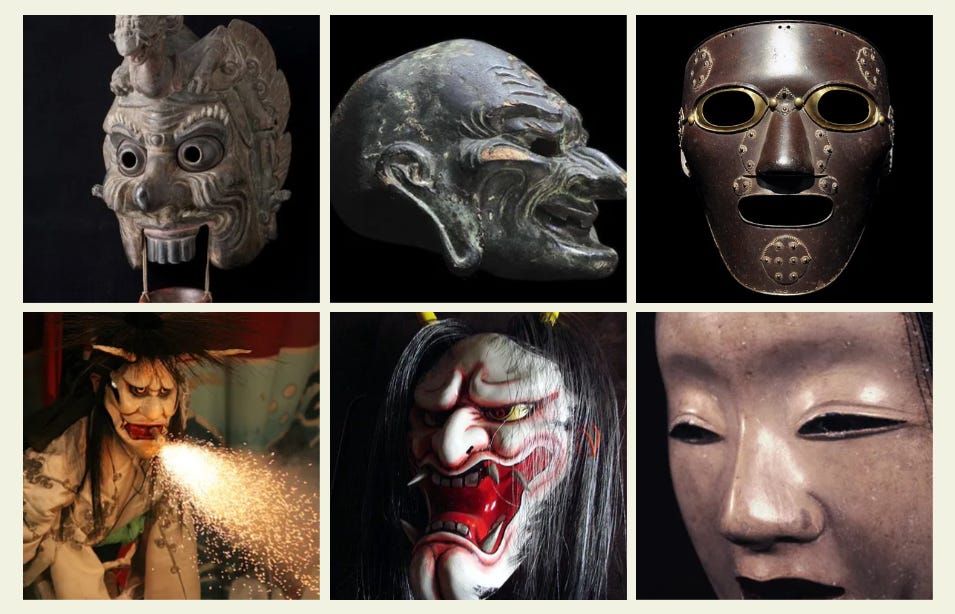
Western horror works more often with the aforementioned climax or catharsis of unmasking. The mask signifies a hidden identity, transgression, anonymity, bodily disfigurement, and the tension lies in who or what could be underneath. Japanese horror changes the emphasis away from this singular point. J-horror masks and mask-like faces are less revelatory and more relational. An audience in the know will be questioning what has been activated. This relational stance explains the primacy of hygiene masks, faceless spirits and Noh-derived expressions in J-horror. The lank curtain of wet hair hanging over the villain’s face functions in the same way. To take the classic example - Ringu/The Ring - famously the antagonist Sadako/Samara makes use of older onryō/yūrei iconography, along with Noh’s magic to create multiple emotional surface-states from small differences in viewer angles. But, her iconic hair-veil is used very differently between the original Japanese and Western films. In the former it remains an active surface, in the latter it conceals - right up until it reveals the ‘truth’ underneath. What is lost in the translation is the Japanese anti-catharsis, slow dread, the lingering unease.
Aside from masks, we also find differences in J-horror through its forms of non-Western, non-confessional antagonism. One classic motif that exemplifies this is the relational, rule-bound type of horror villain, where our main characters accidentally find themselves ‘activating’ what feels like a script or protocol. The protocol then moves procedurally through its own logic, ending only when the character dies, or is able to find the ‘exit’ switch - leaving the script fulfilled and awaiting the next victim.
Films based on folklore collected during the Meiji era show this kind of relational, sequence-based curse in action. The 1968 film Yuki-onna / The Snow Woman was based on a reported story in the famous 1904 book Kwaidan: Stories and Studies of Strange Things, written by the Irish-Greek translator Lafcadio Hearn - who himself transcribed it first hand from a farmer in Musashi Province. It depicts the story of two sculptors who cut down a tree to carve as a Buddhist statue, triggering the wrath of a Yoki-onna spirit. The sequence unfolds like paper - an encounter, a warning, a prohibition and a consequence. As Japanese ghost/horror films moved into the modern era, the use of contemporary technology to act as the medium for the deadly scripts became one of its defining features. The infamous urban legend of Kuchisake-onna, or the ‘Slit-Mouthed Woman’, follows a flow diagram-like interaction sequence in which the wrong answer leads to death and the right answer leads to mutilation. Proposed ‘cheats’ and tricks have appeared over the years, with internet forum users trying to logically determine the best form of escape, should any of them come across Kuchisake-onna on the street.
Future fusions - digital culture, metaphysical battlegrounds
We’ve covered a lot of ground in this essay, examining multiple aspects of Japanese history in an attempt to understand J-horror - and there’s so much more we could have talked about, especially the post-war cultural changes in the country. However, now we turn to the future: J-horror, as just one of many J-culture exports, will continue to be relevant. Despite being somewhat eclipsed by K-horror today, J-horror still has huge value for understanding the current metaphysical anxieties of digital culture. Many of the genre’s most central structures, the contagious media, haunted domestic technologies, recursive scripts, ambient presences, persistence of affect in impersonal system. Every year these appear less like unique stylistic peculiarities than as early descriptions of the networked life. In this respect it departs from both Romance-Gothic localisation and from many Western models of technological horror, where danger is often framed in terms of hubris, scientific overreach or institutional abuse. By contrast, J-horror more often presents media as spiritually and affectively porous.
This logic is now everywhere in the digital present. Contemporary online life is characterised by almost exactly those conditions that J-horror had already explored. We live within replications-without-origins, the circulation of detached faces and voices, persistence of traces, the collapse of clear boundaries between intimate and public spheres and the increasing difficulty of distinguishing presence from simulation. James Earl Jones’ voice lives on past his death, old browser games whirr away without any users, the faces of politicians are public property for manipulation. Social media profiles, algorithmically curated feeds, AI companions, face filters, virtual avatars and synthetic media all intensify the sense that personhood can now be copied and maintained across technical systems that exceed the control of any individual subject. Within such an environment, the older Western model in which the face guarantees interiority becomes unstable. J-horror was way ahead of the game here because it offers neither simple technophobia nor a merely sociological account of mediation. It provides a metaphysics of contaminated transmission, that is to say - a way of imagining how grief, shame, desire, violence, memory can become ambience and self-propagating.
Thus the future significance of J-horror may lie in its ability to shine a light on digital culture as a battleground rather than a technological environment. What counts as a self when images act independently of bodies? What happens to moral agency when scripts and algorithmic repetitions shape action in advance? How should horror be understood when contamination no longer requires physical proximity, but can be encountered through platforms, archives and interfaces? J-horror suggests that these are technologically intensified versions of older concerns with attachment, pollution, possession, ritual failure and the unstable traffic between the visible and invisible worlds.
What we now have is a growing tension between the digital aesthetic dominance of Japan and the metaphysical authority of the West. Japan, and the cultural swirlings from which J-horror emerged, have supplied a disproportionate amount of the aesthetic grammar through which contemporary digital uncanniness is imagined. The digital world resembles a space which functionally ignores or bypasses classical Western distinctions between essence and appearance. Western audiences recognised in J-horror the domestic settings, media devices, social routines and so on, but encountered within them this novel metaphysical logic of shredding and re-arranging the singular, moral, autonomous individual.
Yet if Japan has helped shape an aesthetic vocabulary of the digital uncanny, Western culture continues to exert extraordinary power at the level of moral interpretation. The dominant Anglophone and European response to digital culture still relies on a visibly Western metaphysics of the self, such as authenticity contrasted with performance, one’s inward truth threatened by surface manipulation, human innocence endangered by seductive images, psychic damage understood and revealed through confession and trauma. At the risk of sounding horribly pretentious, we live in an ontological battlefield: much of the online world operates through mask-like interfaces, stylised personae, virtual intimacies, circulating affective residues, things that are more legible through J-horror’s relational and surface-oriented logic than through older Western models. At the same time, public discourse continues to try and cram these phenomena back into moralised frameworks of corruption and hidden harm.
In Western horror, the loss of interiority is usually catastrophic because the face is still expected to testify to ensoulment and authentic feeling. J-horror comes out of and builds on a tradition where an empty form can survive: the face remains correct, the body continues its normal routine but the animating core is thinned-out or absent. In a kind of techno-animist sense, what links the cursed school corridor and wet-haired onryō to modern avatars and synthetic personas is a relay of personhood. Japanese visual culture has long normalised performative and non-naturalistic faces as emotionally operational rather than morally deficient. Anime, masks, dolls, mascots, cosplay, kawaii-core, VTubers and so on all help produce a cultural environment in which the face does not need to be a transparent window into the soul in order to function socially and affectively. A synthetic or artificially generated face is a surface engineered for attachment. They do not need depth in the old Western sense. They need only enough responsiveness and stylisation, some procedural intimacy to hold attention and they inevitably invite projection.
Western modernity interiorised the self, moralised the private life, and made confession, authenticity, trauma and psychic depth central to personhood. Digital culture and technology doesn’t have a simple relationship with this form of selfhood: one the one hand it externalises internality into infinite surfaces (feeds, chats, selfies, reacts, companions, generated voices, confessions, emotional dashboards), on the other it encourages never-ending introspection. Japan is important here because its horror and adjacent media forms often anticipate a world in which interiority no longer belongs securely to the inner person. For a Western person today digital technology is morally suspect and must be held in check to prevent mental corruption, but for non-Western people this core of anxiety is often not present at all. The same features produce different results, due to the cultural conception of how a self is constituted and maintained: arguably the internet causes internalisation without end, the private self endlessly performed, copied, aestheticised, fed back through interfaces. Inner life becomes a loop - agony for some, normality for many, bliss for a few.
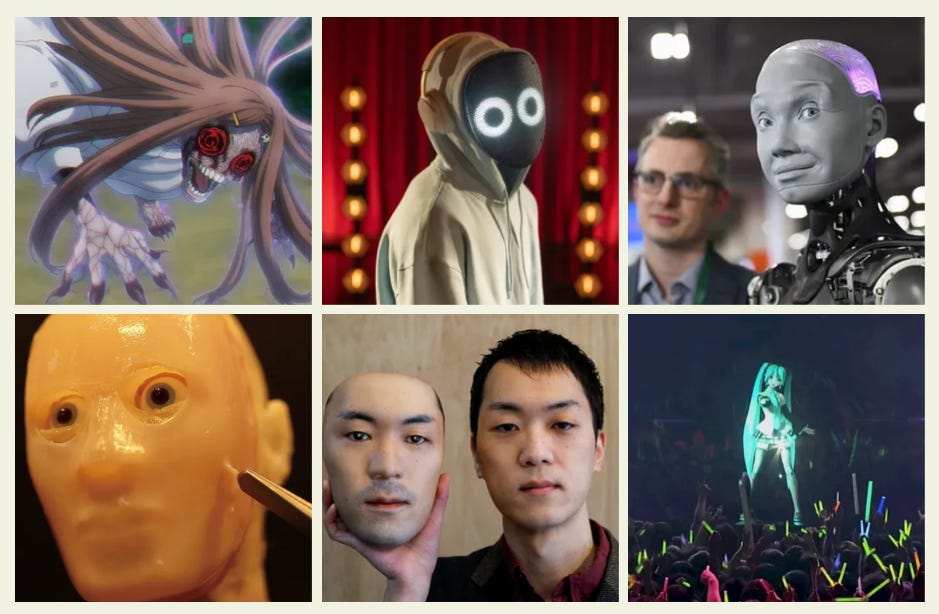
To finish then - J-horror is full of beings and conditions that are neither fully alive nor fully absent, a world without simple psychologically legible subjects nor simple monsters. What lingers on instead is the residue. This could be an attachment without a body, or emotion without closure, a face without a person, or repetition without any meaning. What we mean now by artificial intelligence does map well onto J-horror territory, because LLM-based interfaces do not have a core, stable self. In practice this means the chatbot after the breakup, a dead person’s voice model, an AI therapist, virtual idols, masked influencers, tell-tale imprints of synthetic writing, art or music, these are all residues of the human, not replacements for it. Japan matters because it has repeatedly imagined worlds in which these residues are active, adhesive and socially real. When science fiction describes the posthuman it too often imagines a linear progression of human towards machinic, cyborg futures. The posthuman world we’re already in is much more animistic, antagonistic, sticky, much more a contest of European-derived individual values and other, relational web-like worlds-in-the-making. J-horror has skilfully negotiated this tension and found huge success in the West, and hopefully I’ve shown there’s good reason for this. A nation and people who modernised at warp-speed, explored the psychological pain of that process, but were able to take the best of Western tools and hold up a mirror and a road-map in return.
If you enjoyed this work please consider a paid subscription or browse my books on Amazon. I always aim to write high quality articles covering the macabre and darker sides of anthropology and archaeology, as well as coverage of contemporary science topics and my own personal takes on philosophy, history and art. Your support really helps me continue this project, thank-you!
It'd be fascinating to see more cross-cultural discussion of the horror created by differing cultures, unless they primarily fall into derivation from W&J. I think I see what you mean by K Horror being arguably derivative, and its possible other Eastern expressions of horror are similarly pollinated by Western/J influences (Damn is The Wailing a great J Horror made by Koreans though). I recall however finding an intriguing tip toeing into Thai horror as distinct from its contemporaries discussed by a Chinese film analyst some years back. https://youtu.be/C4grGUdenhg?si=f7a_u6cqRd70HB74 May be ultimately derivative, but may also pique your interest.
Wow this is phenomenal thank you